Operations · 35-45% of the test
Part 107 Operations Practice Questions
Operations is the biggest area, 35 to 45 percent of the test, and the widest: how you communicate, make decisions, stay fit to fly and keep the aircraft airworthy.
- 285 questions, all free
- 23 on FAA figures
- No sign-up
- Explained from FAA texts
Which is both the best prevention and the best cure for hyperventilation?
What to know
- Before each flight the remote pilot must check the aircraft system to decide whether it is in a condition for safe operation, and must stop the flight if it is no longer safe. The FAA suggests a preflight checklist.14 CFR 107.15 and AC 107-2A
- Alcohol: no flying within 8 hours of drinking, under the influence, or at a blood alcohol concentration of .04 percent or more. A remote pilot must not fly with a medical condition that would interfere with safe operation.14 CFR 107.27, 107.17
- The IMSAFE mnemonic checks you before a flight: Illness, Medication, Stress, Alcohol, Fatigue, Emotion.Remote Pilot Study Guide, Physiology
- The five hazardous attitudes are anti-authority, impulsivity, invulnerability, macho and resignation, and each has an antidote to recall.Remote Pilot Study Guide, Aeronautical Decision-Making
- At an airport without a control tower, selecting the right common frequency (CTAF) is the key to communicating. A MULTICOM frequency of 122.9 is used where there is no tower, flight service station or UNICOM.Remote Pilot Study Guide, Radio Communication
- In an emergency needing immediate action the remote pilot may deviate from any Part 107 rule as far as needed, and must send a written report to the FAA on request.14 CFR 107.21
- Night flying needs a test or training updated for night operations and anti-collision lighting visible for at least 3 statute miles. The same lighting is needed during civil twilight.14 CFR 107.29
ACS tasks in this area
The FAA's Airman Certification Standards list what the test covers. Our questions are tagged to these tasks.
- V.A Radio Communications Procedures39 practice questions
- V.B Airport Operations64 practice questions
- V.C Emergency Procedures45 practice questions
- V.D Aeronautical Decision-Making46 practice questions
- V.E Physiology53 practice questions
- V.F Maintenance and Inspection Procedures38 practice questions
More practice
Other areas of the Part 107 test, and the mixed practice tests.
Flight Ready
Practice until you're ready for the real test
Every practice question is free. Flight Ready adds:
- The exam simulator: 60 questions by the real test's mix, a 2-hour timer, answers only at the end
- My mistakes: each miss comes back until you get it right twice in a row
- Weak-spot drills from your lowest-scoring ACS tasks, and a readiness view
- Your scores and mistakes on every device you log in on
- Paid once, US$4.49. Never a subscription
14-day refunds, no questions asked.
Operations test 1: questions and answers
-
1. Which is both the best prevention and the best cure for hyperventilation?
- Taking medication
- Breathing normally
- Flying at a lower altitude
Show the answer
B. Breathing normally Controlled, normal breathing restores the right level of carbon dioxide. Remote Pilot Study Guide, page 54
-
2. How far from a non-towered airport should an inbound manned aircraft pilot start monitoring and communicating on the CTAF?
- 3 miles
- 5 miles
- 10 miles
Show the answer
C. 10 miles Inbound pilots are advised to use the CTAF from 10 miles out until landing. A remote pilot near the airport may hear calls from aircraft that are much farther away than they can see. AIM 4-1-9
-
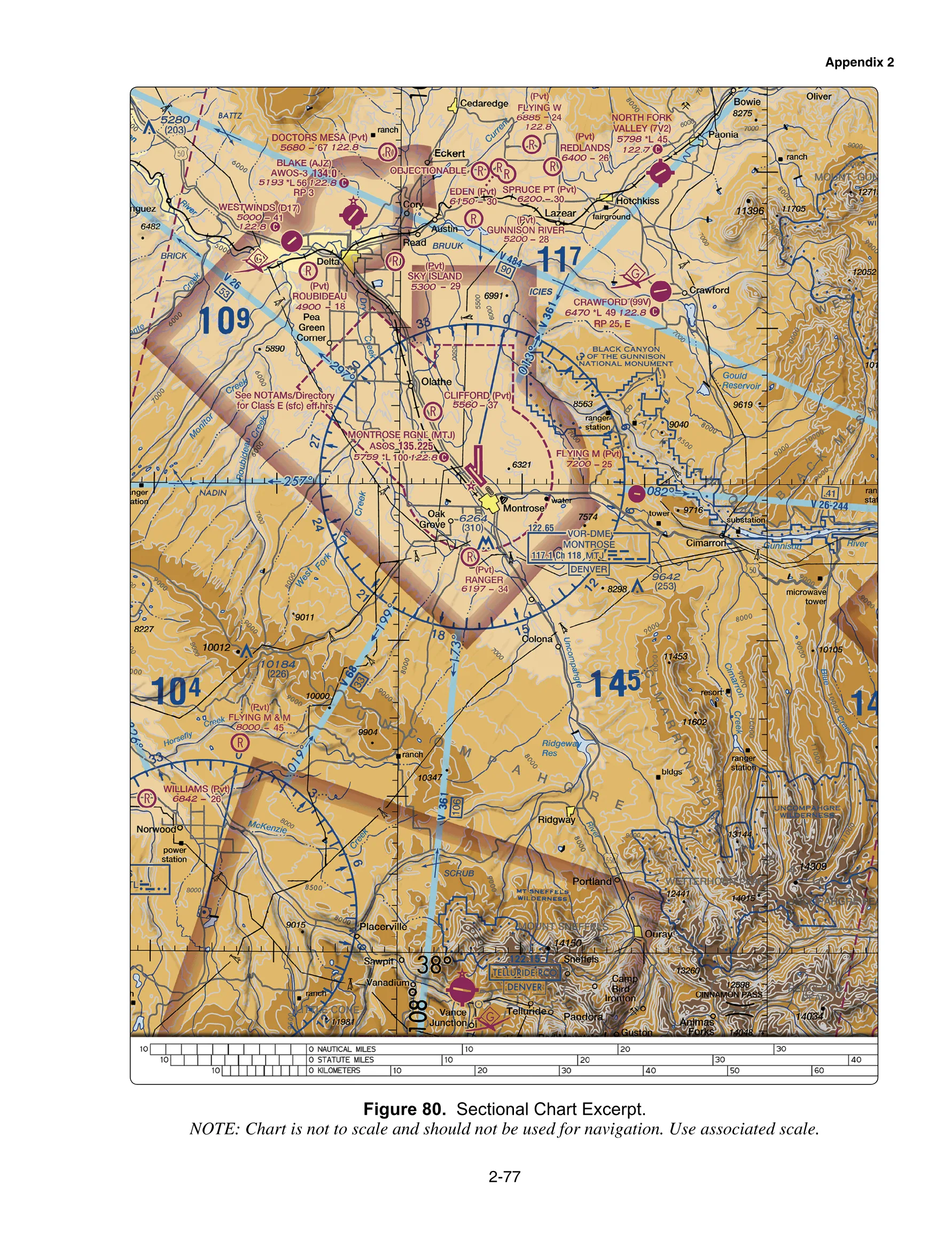
3. (Figure 80) Montrose Rgnl (MTJ) is labeled 5759 *L 100 122.8. How long is its longest runway?
FAA-CT-8080-2H, Figure 80 - About 1,000 feet
- About 10,000 feet
- About 5,759 feet
Show the answer
B. About 10,000 feet Runway length is shown in hundreds of feet, so 100 means about 10,000 feet. The 5759 is the airport elevation. Chart Users' Guide, page 15
-
4. What is the minimum exposure to total darkness required for complete dark adaptation?
- 5 minutes
- 60 minutes
- 30 minutes
Show the answer
C. 30 minutes A moderate degree can be reached within 20 minutes under dim red light. AIM 8-1-6
-
5. When a pilot is dealing with more than the usual difficulties in everyday life, what should the pilot consider?
- Flying anyway to take the mind off them
- Delaying the flight until the difficulties are resolved
- Flying with a visual observer only
Show the answer
B. Delaying the flight until the difficulties are resolved Stress from home or work can reduce alertness and lead to unwarranted risks. AIM 8-1-1
-
6. A battery casing is bulging. What may this show?
- A fully charged battery in good condition
- Impending failure that could cause abrupt power loss or an explosion
- A normal sign of a battery at the end of a flight
Show the answer
B. Impending failure that could cause abrupt power loss or an explosion A distorted battery casing is a warning sign, so the battery should be inspected and not used until its integrity is known. AC 107-2A, page 95
-
7. Which publication gives the most comprehensive information about a given airport?
- The Chart Supplement U.S.
- A sectional chart
- The ATIS broadcast
Show the answer
A. The Chart Supplement U.S. The Chart Supplement U.S. (formerly the Airport/Facility Directory) lists detailed airport data, including frequencies and services. Remote Pilot Study Guide, page 74
-
8. Which concept is part of single-pilot resource management?
- Airspace authorization
- Task management
- Weight and balance computation
Show the answer
B. Task management SRM includes ADM, risk management, task management, automation management, CFIT awareness and situational awareness. Remote Pilot Study Guide, page 61
-
9. To be eligible for a remote pilot certificate, what must be true about the applicant's health?
- Holds a current FAA medical certificate
- Does not know of a condition that would interfere with safe operation
- Has passed a drug test within 90 days
Show the answer
B. Does not know of a condition that would interfere with safe operation No FAA medical certificate is needed. The applicant just must not know or have reason to know of a condition that would interfere with safe operation. 14 CFR 107.61
-
10. At night, what can a remote pilot not rely on alone to meet the visual line of sight rule?
- Corrective lenses
- The aircraft's anti-collision lighting, telemetry displays, or both together
- Unaided eyesight and corrective lenses
Show the answer
B. The aircraft's anti-collision lighting, telemetry displays, or both together The pilot must still be able to see the aircraft. Lights and telemetry displays are not enough on their own. AC 107-2A, page 25
-
11. How many hazardous attitudes have studies identified that can interfere with sound decisions?
- Five
- Three
- Seven
Show the answer
A. Five The five are anti-authority, impulsivity, invulnerability, macho, and resignation. Pilot's Handbook of Aeronautical Knowledge, page 44
-
12. In the 3P model, what does the CARE checklist stand for?
- Consequences, Alternatives, Reality, External factors
- Cost, Assessment, Review, Evaluation
- Capability, Aircraft, Regulations, Environment
Show the answer
A. Consequences, Alternatives, Reality, External factors CARE is used in the Process step to evaluate each hazard you perceived. Pilot's Handbook of Aeronautical Knowledge, page 55
-
13. What is the safest rule about flying while suffering from an illness?
- Do not fly while suffering from any illness
- Fly if the symptoms are mild
- Fly if a medication controls the symptoms
Show the answer
A. Do not fly while suffering from any illness Even a minor illness can reduce performance. AIM 8-1-1
-
14. What do mandatory instruction signs denote?
- The direction to a different taxiway
- An entrance to a runway, critical area, or prohibited area
- The distance of runway remaining
Show the answer
B. An entrance to a runway, critical area, or prohibited area Mandatory instruction signs have a red background and white inscription. They mark places where a pilot must stop or get permission to proceed. Pilot's Handbook of Aeronautical Knowledge, page 349
-
15. Which condition can start a lithium battery fire?
- Charging the battery to full just before a flight
- A battery that was damaged in a crash
- Storing the battery in a cool place away from heat
Show the answer
B. A battery that was damaged in a crash Short circuits, improper charging, extreme heat, crash damage, rough handling and defects can all cause lithium battery fires. AC 107-2A, page 92
-
16. Which is one way a pilot can share intentions and get traffic information at an airport with no operating tower?
- Make a self-announce broadcast
- Ask the tower for a clearance
- Request radar vectors from approach control
Show the answer
A. Make a self-announce broadcast At an airport with no operating tower, pilots can talk to an FSS, talk to a UNICOM operator, or broadcast their own position and intentions (self-announce). Remote Pilot Study Guide, page 48
-
17. During automated flight, what must the remote PIC be able to do?
- Leave the control station once the autopilot has the flight plan
- Hand responsibility for the flight to the autopilot
- Change the routing or altitude, or command the aircraft to land immediately
Show the answer
C. Change the routing or altitude, or command the aircraft to land immediately Automation does not remove the remote PIC's responsibility. The remote PIC must keep the ability to redirect the aircraft or land it. AC 107-2A, page 20
-
18. When should a remote pilot transmit on an active aviation frequency?
- Only when there is an emergency
- Whenever a manned aircraft comes within 5 miles
- Before every launch from a non-towered airport
Show the answer
A. Only when there is an emergency A remote pilot is not expected to talk with manned aircraft. Staying off the frequency keeps it clear unless an emergency makes a call necessary. Remote Pilot Study Guide, page 49
-
19. A remote pilot regards rules and procedures as silly or unnecessary and resents being told what to do. Which hazardous attitude is this?
- Anti-authority
- Resignation
- Invulnerability
Show the answer
A. Anti-authority Anti-authority describes a person who resents direction and treats rules as unnecessary. The cure is to follow the rules, because they are usually right. Pilot's Handbook of Aeronautical Knowledge, page 44
-
20. What color are omnidirectional taxiway edge lights?
- Green
- White
- Blue
Show the answer
C. Blue Taxiway edge lights are blue. Some taxiways also have green centerline lights. Pilot's Handbook of Aeronautical Knowledge, page 353
-
21. A pilot sees birds or other animals on or near the runway before takeoff. What should the pilot do?
- Take off quickly before they move
- Request that airport management disperse the wildlife before taking off
- Fly the pattern once to scare them off
Show the answer
B. Request that airport management disperse the wildlife before taking off Wildlife on or near a runway is a collision hazard. The pilot should ask airport management to clear it first. AIM 7-5-4
-
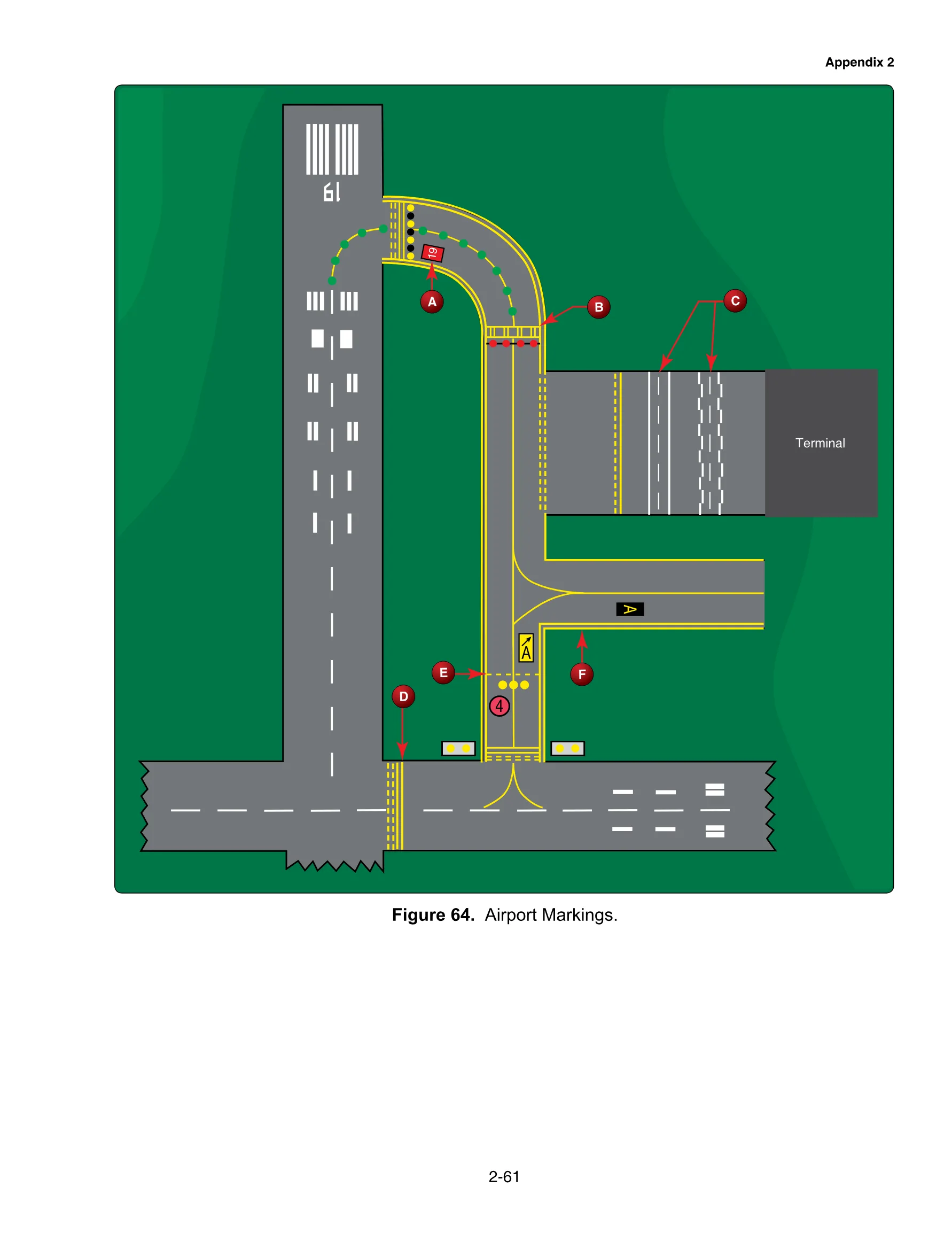
22. (Figure 64, area B) What does the yellow ladder-style marking across the taxiway show?
FAA-CT-8080-2H, Figure 64 - The ILS critical area holding position
- The edge of the taxiway
- A vehicle roadway crossing
Show the answer
A. The ILS critical area holding position A horizontal yellow ladder across a taxiway marks where aircraft must hold short of the ILS critical area. Vehicle roadways use white lines and taxiway edges use double yellow lines. Pilot's Handbook of Aeronautical Knowledge, page 346
-
23. Before flight, what must the remote PIC ensure about power?
- Enough power for the system to operate for the intended operational time
- A full charge on every battery, whatever the flight length
- Power for at least 60 minutes of flight
Show the answer
A. Enough power for the system to operate for the intended operational time The rule is about enough power for the planned flight, which the manufacturer's tables or an on-board alert can help determine. 14 CFR 107.49
-
24. A Category 2 aircraft is modified in a way the remote pilot operating instructions do not allow. What is the result?
- The aircraft becomes ineligible for Category 2 operations
- The aircraft stays eligible, if the owner updates the label
- The aircraft becomes a Category 1 aircraft
Show the answer
A. The aircraft becomes ineligible for Category 2 operations Unapproved modifications end eligibility. A new declaration of compliance is needed to fly over people again. AC 107-2A, page 55
-
25. Which item is part of the required assessment of the operating environment before flight?
- The aircraft's total flight hours since new
- Whether the visual observer holds a remote pilot certificate
- The location of persons and property on the surface
Show the answer
C. The location of persons and property on the surface The assessment covers local weather, local airspace and flight restrictions, persons and property on the surface, and other ground hazards. 14 CFR 107.49
Operations FAQ
What does IMSAFE stand for?
Illness, Medication, Stress, Alcohol, Fatigue and Emotion: a self-check before every flight (Remote Pilot Study Guide).
What are the five hazardous attitudes?
Anti-authority, impulsivity, invulnerability, macho and resignation (Remote Pilot Study Guide, Aeronautical Decision-Making).
When may a remote pilot deviate from a Part 107 rule?
In an in-flight emergency that needs immediate action, to the extent necessary to meet it. If the FAA asks, the pilot must send a written report (14 CFR 107.21).
What lighting does a drone need at night?
Lighted anti-collision lighting visible for at least 3 statute miles with a flash rate that avoids a collision; you may reduce its intensity for safety but not turn it off (14 CFR 107.29).
Is operations the biggest part of the test?
Yes. The ACS gives it 35 to 45 percent of the questions, so on the 60-question test it is the largest share.