FAA remote pilot knowledge test
Free Part 107 Practice Test
Practice for the FAA Part 107 knowledge test, the test for a commercial drone license. Every question is free, with the answer explained and linked to the FAA text it comes from. No sign-up.
- 685 questions, all free
- No sign-up
- 60-question practice tests
- Answers explained from FAA texts
- No ads
Under PAVE, a remote pilot asks whether the aircraft can carry the planned load. Which category is this?
Practice by topic
The real test covers five areas from the FAA's remote pilot standards. Pick one to focus on, or work through the sectional chart figures.
About the real test
The FAA's Part 107 knowledge test has 60 multiple-choice questions and gives you up to two hours. 70% or better passes. Our practice tests use the same pass mark, and each answer links to the FAA document it comes from.
Flight Ready
Practice until you're ready for the real test
Every practice question is free. Flight Ready adds:
- The exam simulator: 60 questions by the real test's mix, a 2-hour timer, answers only at the end
- My mistakes: each miss comes back until you get it right twice in a row
- Weak-spot drills from your lowest-scoring ACS tasks, and a readiness view
- Your scores and mistakes on every device you log in on
- Paid once, US$4.49. Never a subscription
14-day refunds, no questions asked.
Practice test 1: questions and answers
The same questions as test 1 above, to read through. Open an answer to see why.
-
1. Under PAVE, a remote pilot asks whether the aircraft can carry the planned load. Which category is this?
- Pilot
- External pressures
- Aircraft
Show the answer
C. Aircraft Questions about the aircraft's suitability, currency in it, and load capacity belong in the Aircraft category. Remote Pilot Study Guide, page 63
-
2. Can ADS-B Out equipment be used to meet the remote identification requirements of part 89?
- Yes, on any aircraft over 0.55 pounds
- Yes, but only in Class B airspace
- No, it cannot be used
Show the answer
C. No, it cannot be used Part 89 specifically says ADS-B Out cannot be used for remote ID, so it must be met by standard remote ID, a broadcast module or a FRIA. 14 CFR 89.125
-
3. Why does thin air reduce the thrust a propeller produces?
- The propeller is less efficient in thin air
- The propeller blades become heavier in thin air
- The thin air exerts more force on the blades
Show the answer
A. The propeller is less efficient in thin air Less dense air cuts power, thrust and lift. A propeller moves less air per turn, so it makes less thrust. Pilot's Handbook of Aeronautical Knowledge, page 258
-
4. Is participation in airport advisory programs mandatory for pilots?
- Yes, in all controlled airspace
- No, it is not mandatory
- Yes, but only for drones
Show the answer
B. No, it is not mandatory Advisory programs are a service pilots may use, not a requirement. AIM 3-5-1
-
5. Where are permanent MOAs charted?
- Only on IFR En Route High Altitude charts
- On Sectional, VFR Terminal Area, and En Route Low Altitude charts
- Only in the Chart Supplement U.S.
Show the answer
B. On Sectional, VFR Terminal Area, and En Route Low Altitude charts Permanent MOAs show on the charts a drone pilot uses to plan a flight. AIM 3-4-5
-
6. Under the Part 107 rule on alcohol or drugs, which sections must a remote pilot comply with?
- Sections 91.17 and 91.19
- Sections 107.17 and 107.19
- Sections 61.23 and 67.103
Show the answer
A. Sections 91.17 and 91.19 Part 107 ties its alcohol and drug rules to the general operating rules in Part 91. 14 CFR 107.27
-
7. The Category 2 label on an aircraft has peeled off. Who must provide a new label before flying over people?
- The manufacturer who holds the declaration of compliance
- The FAA
- The remote pilot
Show the answer
C. The remote pilot A missing or unreadable label makes the aircraft ineligible. The remote pilot must replace it so it correctly shows the eligible category before flying over people. AC 107-2A, page 74
-
8. During what period must a standard remote identification aircraft broadcast its message elements?
- From takeoff to shutdown
- Only while above 400 feet AGL
- Only when in controlled airspace
Show the answer
A. From takeoff to shutdown Broadcasting is continuous for the entire operation, not only during parts of the flight. 14 CFR 89.110
-
9. (Figure 26) Restricted area R-5402 is charted north of Jamestown. Whose authorization is needed to fly into it when it is active?
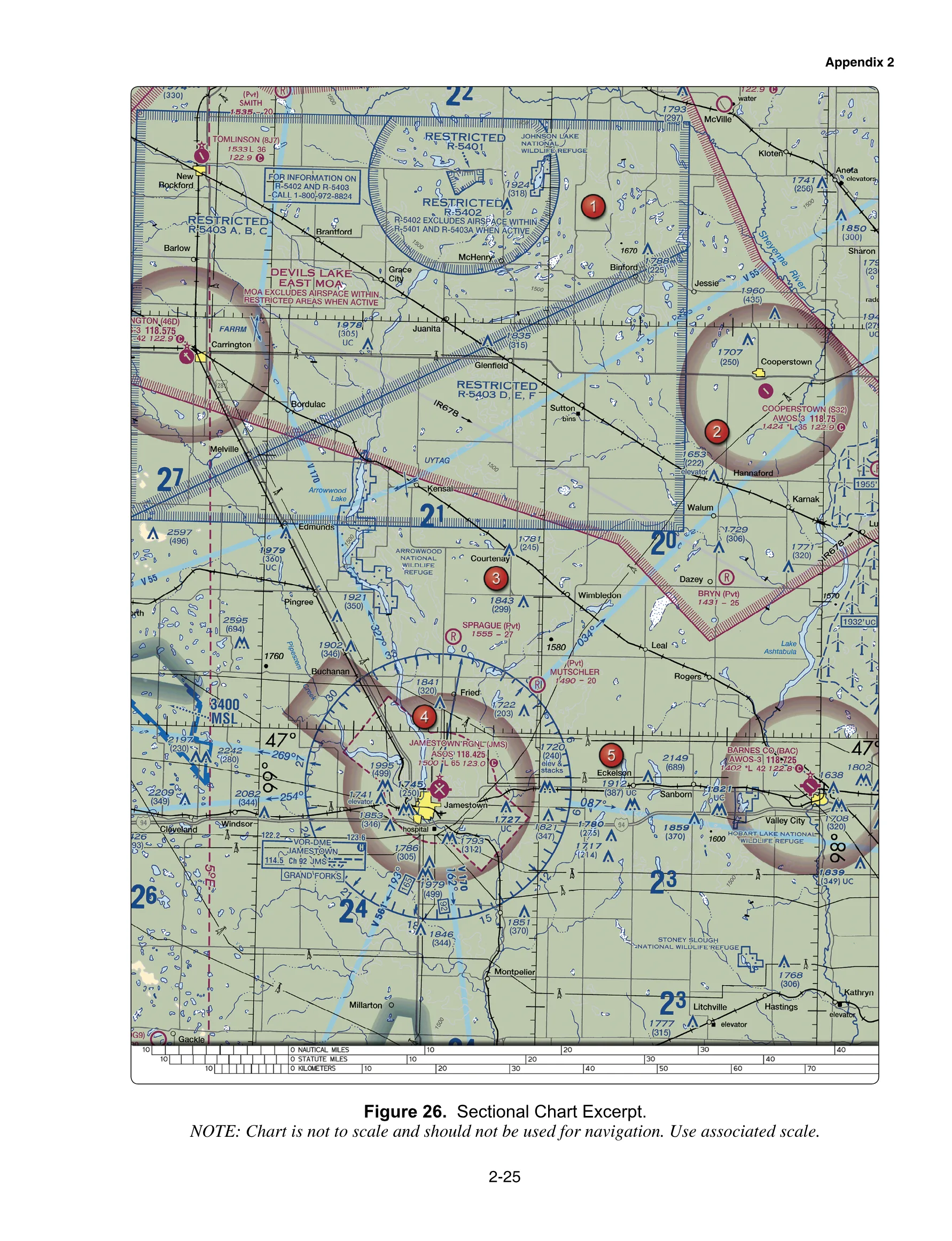
FAA-CT-8080-2H, Figure 26 - The nearest airport manager
- The nearest control tower
- The using or controlling agency
Show the answer
C. The using or controlling agency Restricted areas hide unusual hazards such as artillery firing or guided missiles. Entering one without authorization from the using or controlling agency can be extremely hazardous. AIM 3-4-3
-
10. What is needed to fly a small unmanned aircraft in a prohibited or restricted area?
- Permission from the using or controlling agency
- A waiver from the airport manager
- Nothing if flying below 400 feet
Show the answer
A. Permission from the using or controlling agency The using or controlling agency, such as the military, gives permission for these areas. 14 CFR 107.45
-
11. A Category 2 aircraft is modified in a way its remote pilot operating instructions do not allow. What is the result?
- It becomes ineligible for operations over people
- It stays eligible as long as the label is still attached
- It becomes eligible for Category 3 operations automatically
Show the answer
A. It becomes ineligible for operations over people Unapproved changes can break the basis of the aircraft's declaration of compliance. The aircraft is no longer eligible, and a new declaration is needed to fly over people again. AC 107-2A, page 55
-
12. When should manned aircraft pilots use the phonetic alphabet to identify their aircraft?
- Only during an emergency
- During initial contact with air traffic control facilities
- Only on UNICOM frequencies
Show the answer
B. During initial contact with air traffic control facilities The ICAO phonetic alphabet helps controllers hear letters correctly. Pilots use it for their aircraft identification when first calling ATC. AIM 4-2-7
-
13. A standard remote ID aircraft's remote ID equipment is not functional. What must be true about taking off?
- It may take off with a warning to the pilot
- The aircraft must not be able to take off
- It may take off if flown in a FRIA
Show the answer
B. The aircraft must not be able to take off A standard remote ID aircraft tests its equipment before takeoff and must not take off if the equipment does not work. 14 CFR 89.310
-
14. A remote pilot thinks "What's the use?" and leaves decisions to others, crediting good or bad luck for outcomes. Which hazardous attitude is this?
- Impulsivity
- Resignation
- Macho
Show the answer
B. Resignation Resignation is the feeling of being unable to influence what happens, so the pilot leaves the action to others. Pilot's Handbook of Aeronautical Knowledge, page 44
-
15. Which visual signal is often used at each end of a temporarily closed runway?
- Yellow Xs, sometimes raised and lighted
- A white threshold bar painted across the runway
- Blue edge lights
Show the answer
A. Yellow Xs, sometimes raised and lighted Temporary closures are often shown with yellow Xs laid flat or lighted. A visual sign is not always present, so pilots also check NOTAMs. Pilot's Handbook of Aeronautical Knowledge, page 349
-
16. Which force is the only one that counteracts weight and keeps an aircraft in flight?
- Drag
- Inertia
- Lift
Show the answer
C. Lift Only lift opposes weight. Lift is limited by airfoil design, angle of attack, airspeed and air density, so loading beyond the recommended weight must be avoided. Remote Pilot Study Guide, page 40
-
17. Why must the remote PIC be able to take immediate control from a person manipulating the controls?
- So the remote PIC can quickly address any hazardous situation
- So the person at the controls can log flight hours
- So the aircraft can be flown without a visual observer
Show the answer
A. So the remote PIC can quickly address any hazardous situation A person without a remote pilot certificate may fly only while directly supervised, and the remote PIC must be able to take over at once. AC 107-2A, page 19
-
18. How often is ATIS normally updated?
- Every 15 minutes
- Every 30 minutes
- Once per hour
Show the answer
C. Once per hour ATIS is normally refreshed once an hour, and sooner if local conditions change. Remote Pilot Study Guide, page 75
-
19. What causes advection fog?
- Cold air moving over warmer water
- The ground cooling by radiation on a clear night
- Moist air moving over a colder surface
Show the answer
C. Moist air moving over a colder surface Advection means horizontal movement. Moist air that blows over a colder surface cools below its dew point. Cold air over warm water makes steam fog. Aviation Weather Handbook, page 232
-
20. A METAR includes the group R17L/1400FT. What does it report?
- A cloud base of 1,400 feet over runway 17 left
- A visual range of 1,400 feet on runway 17 left
- A visual range of 1,400 meters on runway 17 left
Show the answer
B. A visual range of 1,400 feet on runway 17 left R means runway visual range (RVR). The group gives the runway, then the distance a pilot can see down it, in feet in the U.S. Remote Pilot Study Guide, page 24
-
21. Outside Alaska, when does evening civil twilight run?
- From 30 minutes before sunset until official sunset
- From official sunset until 30 minutes after official sunset
- From 30 minutes after sunset until 60 minutes after sunset
Show the answer
B. From official sunset until 30 minutes after official sunset Evening civil twilight starts at official sunset and ends 30 minutes later. 14 CFR 107.29
-
22. Which of these operations does Part 107 NOT apply to?
- Aerial photography flown for pay
- A roof inspection flown for a business
- Air carrier operations
Show the answer
C. Air carrier operations Part 107 lists air carrier operations among the operations it does not apply to. Ordinary commercial work such as photography or inspections falls under Part 107. 14 CFR 107.1
-
23. An aircraft is picking up ice in flight. What should be the first course of action?
- Fly faster to shake the ice off
- Leave the area of visible moisture
- Stay in the cloud and wait for the ice to melt
Show the answer
B. Leave the area of visible moisture Ice needs visible moisture. Get out of it by changing altitude or course. Staying in it only makes the ice build up. Aviation Weather Handbook, page 257
-
24. Where can a pilot learn about a runway or taxiway closure when no visual closure marking is present?
- From the NOTAMs and the ATIS
- From the color of the airport beacon
- From the airport's distance remaining signs
Show the answer
A. From the NOTAMs and the ATIS A closure may have no visual indication, so NOTAMs and the ATIS are the places to check before operating near an airport. Pilot's Handbook of Aeronautical Knowledge, page 349
-
25. In the 3P model, which checklist helps a pilot choose and implement risk controls?
- PAVE: Pilot, Aircraft, enVironment, External pressures
- TEAM: Transfer, Eliminate, Accept, Mitigate
- CARE: Consequences, Alternatives, Reality, External factors
Show the answer
B. TEAM: Transfer, Eliminate, Accept, Mitigate TEAM is used in the Perform step to decide what to do about each risk. Pilot's Handbook of Aeronautical Knowledge, page 55
-
26. In Class G airspace, what coordination with ATC is needed to fly up to 400 feet AGL?
- A call to the nearest tower before each flight
- An authorization from LAANC for every flight
- None, no prior coordination with ATC is needed
Show the answer
C. None, no prior coordination with ATC is needed Class G is uncontrolled, so a Part 107 pilot who stays within the operating limits needs no prior ATC coordination. AIM 11-4-2
-
27. (Figure 75) Alert Area A-231 is charted. Who is responsible for avoiding collisions inside an alert area?
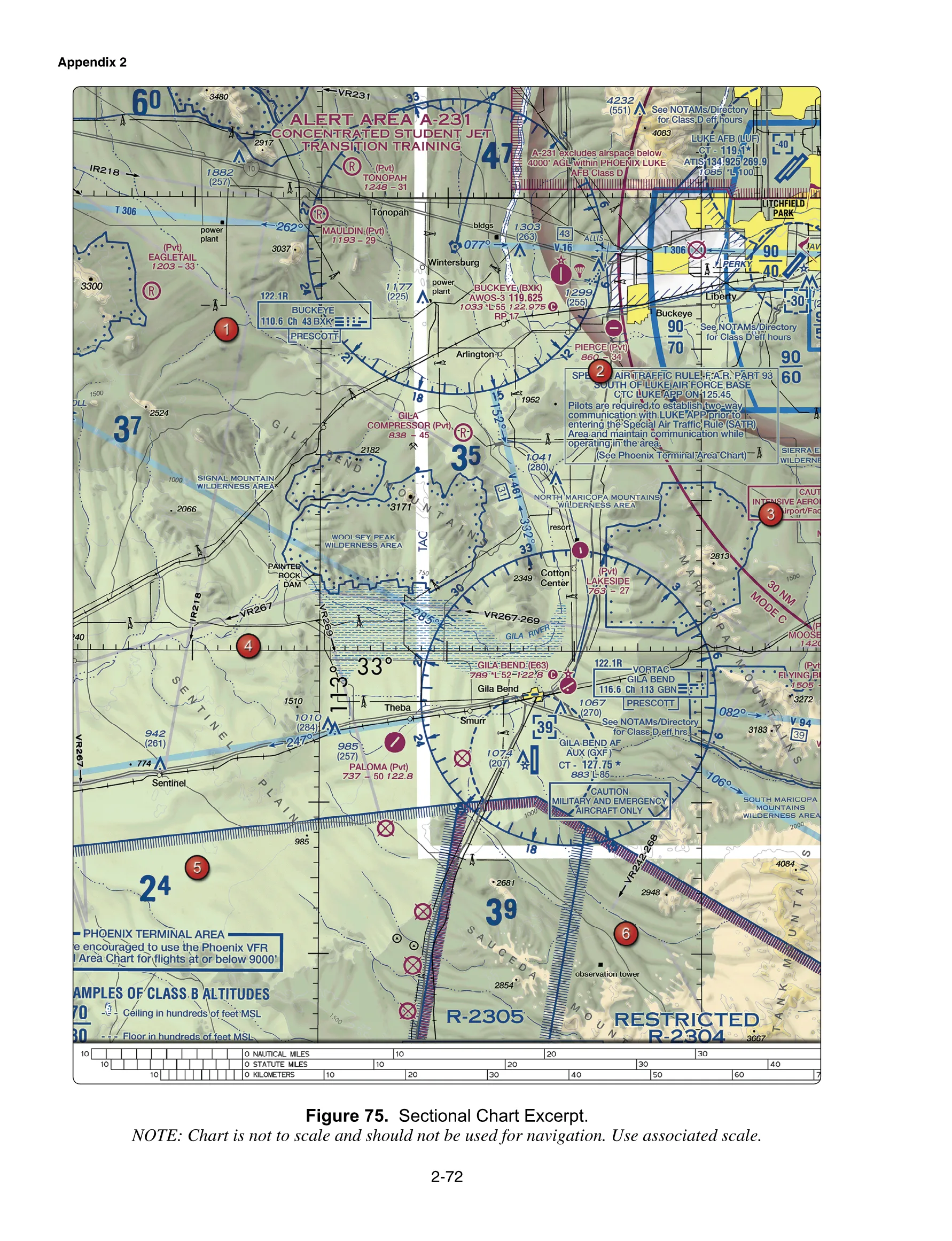
FAA-CT-8080-2H, Figure 75 - Only the pilots of participating aircraft
- Pilots of participating aircraft and pilots transiting the area equally
- Only the controlling military agency
Show the answer
B. Pilots of participating aircraft and pilots transiting the area equally Alert areas hold heavy training or unusual activity but remain open. Every pilot inside, participating or just passing through, shares collision avoidance duty. AIM 3-4-6
-
28. As fuel is used during a flight, what happens to the aircraft's performance and balance?
- Performance improves, but balance may be affected
- Performance drops, but balance is not affected
- Neither performance nor balance changes
Show the answer
A. Performance improves, but balance may be affected Burning fuel makes the aircraft lighter, which helps performance. The weight that leaves can shift the CG, so balance may suffer. Remote Pilot Study Guide, page 37
-
29. At night, how can you tell that another aircraft is approaching rather than moving away?
- Its lights dim
- Its lights increase in intensity
- Its lights stay the same
Show the answer
B. Its lights increase in intensity Reversible perspective can fool you, so watch the light intensity and the horizon. Pilot's Handbook of Aeronautical Knowledge, page 449
-
30. What should an operator do if the manufacturer provides no scheduled maintenance instructions?
- Establish a scheduled maintenance protocol
- Skip scheduled maintenance
- Wait for the FAA to issue a schedule
Show the answer
A. Establish a scheduled maintenance protocol The operator should set up a protocol, for example by documenting repairs and time-in-service, so a reliable schedule builds up. AC 107-2A, page 41
-
31. What does a runway holding position sign look like?
- White characters outlined in black on a red background
- Black characters on a yellow background
- Yellow characters on a black background
Show the answer
A. White characters outlined in black on a red background This sign is red with white letters and is often compared to a stop sign. It marks the point where a taxiing aircraft must stop before a runway. Pilot's Handbook of Aeronautical Knowledge, page 341
-
32. What is true of the performance data published by different small unmanned aircraft manufacturers?
- It follows one format required by the FAA
- It is not standardized
- It is identical for all aircraft of the same weight
Show the answer
B. It is not standardized Each manufacturer presents its data in its own way, so the remote pilot has to read the data for the specific aircraft carefully. Remote Pilot Study Guide, page 51
-
33. What should the remote PIC consider about the anti-collision light during the preflight check?
- It could cause the aircraft to lose its GPS signal
- It must be switched off if the aircraft is below 400 feet AGL
- It could reduce the power available, so the planned flight time may need to be shorter
Show the answer
C. It could reduce the power available, so the planned flight time may need to be shorter Powering the light uses battery energy, so the pilot may need to shorten the operation to keep enough power for a normal landing. AC 107-2A, page 28
-
34. (Figure 12, KINK) What peak gust speed does the wind group 11012G18KT report?
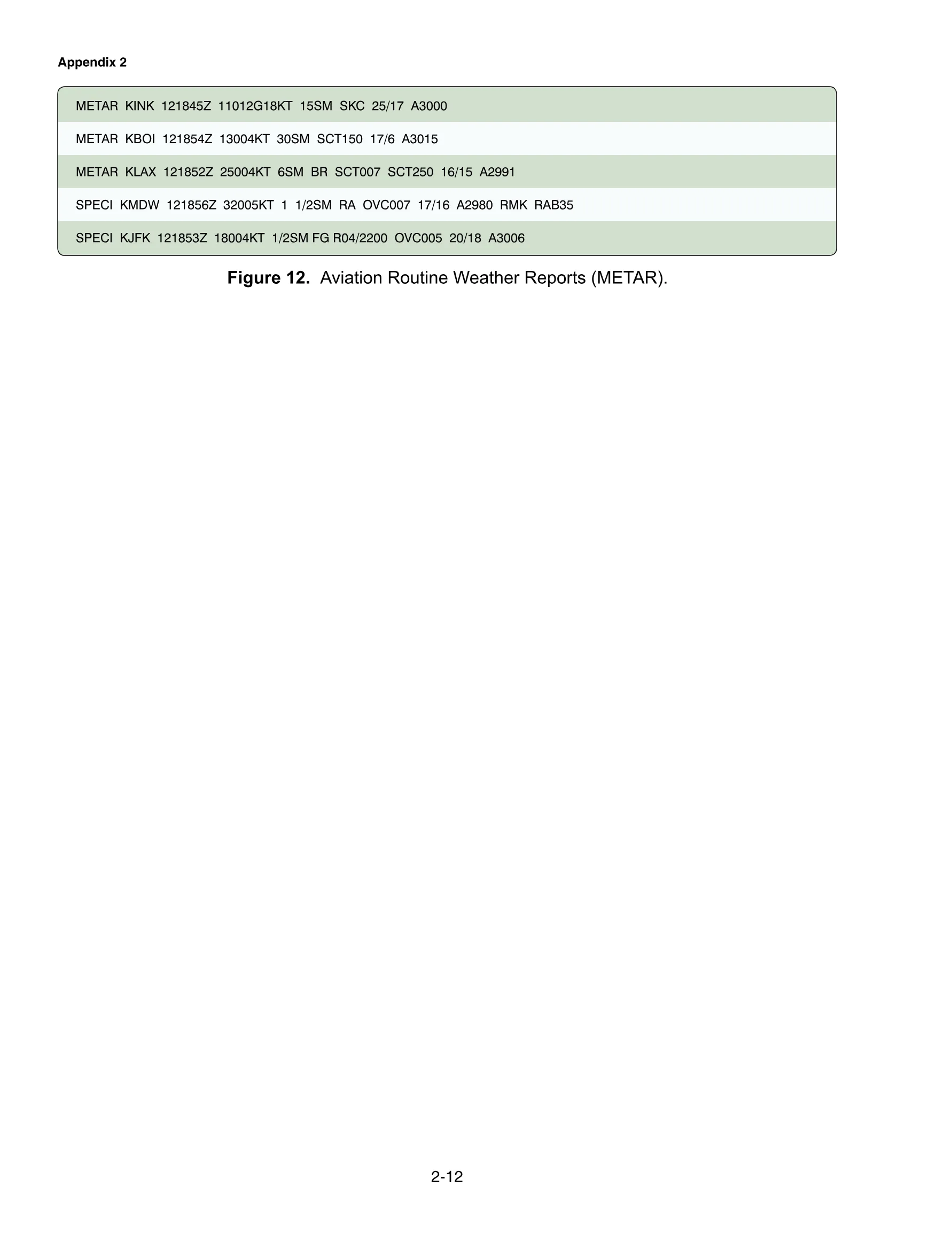
FAA-CT-8080-2H, Figure 12 - 12 knots
- 18 knots
- 25 knots
Show the answer
B. 18 knots In a METAR wind group, the letter G is followed by the peak gust. The wind is steady at 12 knots, with gusts up to 18 knots. Pilot's Handbook of Aeronautical Knowledge, page 316
-
35. How is an altitude of 12,500 feet MSL spoken on the radio?
- Twelve thousand five hundred
- One two thousand five hundred
- One two five hundred
Show the answer
B. One two thousand five hundred Below 18,000 feet MSL, say the separate digits of the thousands and then the hundreds. So 12,500 becomes “one two thousand five hundred.” AIM 4-2-9
-
36. During an automated flight, what must the remote PIC retain?
- The ability to set the flight plan only before takeoff
- The ability to switch off the control link
- The ability to direct the aircraft to ensure compliance with Part 107
Show the answer
C. The ability to direct the aircraft to ensure compliance with Part 107 Even in automated flight the remote PIC must be able to change the route or altitude, or have the aircraft land right away. AC 107-2A, page 20
-
37. After which date may no person operate an unmanned aircraft in US airspace unless it meets the remote ID rules?
- September 16, 2023
- September 16, 2022
- September 16, 2024
Show the answer
A. September 16, 2023 Operations must meet standard or alternative remote ID after this date. The 2022 date is when producers had to begin making standard remote ID aircraft. 14 CFR 89.105
-
38. Where does Class G airspace extend from and to?
- From the surface to the base of the overlying Class E airspace
- From 1,200 feet AGL to 18,000 feet MSL
- From the surface to 400 feet AGL only
Show the answer
A. From the surface to the base of the overlying Class E airspace Class G is the uncontrolled airspace at the bottom, ending where Class E begins above it. Remote Pilot Study Guide, page 14
-
39. What signals that a thunderstorm cell has entered the mature stage?
- A cumulus tower is growing fast and no rain has fallen yet
- The rain has ended and only cloud remnants remain
- Precipitation begins to fall from the cloud base
Show the answer
C. Precipitation begins to fall from the cloud base Falling rain drags air down and creates a downdraft next to the updraft. That marks the start of the mature stage. Remote Pilot Study Guide, page 35
-
40. What is the minimum flight visibility required, observed from the control station?
- 1 statute mile
- 3 statute miles
- 5 statute miles
Show the answer
B. 3 statute miles Flight visibility must be at least 3 statute miles from the control station. 14 CFR 107.51
-
41. What are the 5 Ps used in single-pilot resource management?
- Plan, Power, Position, Propeller, Procedure
- Plan, Plane, Pilot, Passengers, Programming
- Pilot, Payload, Performance, Place, Permit
Show the answer
B. Plan, Plane, Pilot, Passengers, Programming The 5 Ps are reviewed at several points before and during the flight. Pilot's Handbook of Aeronautical Knowledge, page 52
-
42. When does the first sign of poor performance from improper loading usually show up?
- During cruise flight
- During landing
- During takeoff
Show the answer
C. During takeoff An overloaded or badly loaded aircraft usually shows its problems first at takeoff, which is why loading must be checked before launch. Remote Pilot Study Guide, page 41
-
43. What is the minimum convective wind speed that makes a thunderstorm severe?
- 50 knots
- 30 knots
- 70 knots
Show the answer
A. 50 knots A thunderstorm is severe if it produces convective winds of 50 knots or more, large hail, or a tornado. Aviation Weather Handbook, page 269
-
44. Which task is included in small UAS maintenance?
- Remote pilot recurrent training
- System software upgrades
- Aircraft registration renewal
Show the answer
B. System software upgrades Maintenance covers overhaul, repair, inspection, modification, replacement and software upgrades of the system and its components. AC 107-2A, page 41
-
45. Which FAA form is used to report a bird or other wildlife strike?
- FAA Form 5200-7
- FAA Form 7711-2
- FAA Form 8710-13
Show the answer
A. FAA Form 5200-7 Pilots are urged to report wildlife strikes on the FAA's Bird/Other Wildlife Strike Report. The data helps airports plan hazard control. AIM 7-5-3
-
46. How much sleep ordinarily cures acute fatigue, along with rest after exertion?
- 2 hours of sound sleep
- 4 hours of sound sleep
- 8 hours of sound sleep
Show the answer
C. 8 hours of sound sleep Acute fatigue is short term and normal in daily life. Remote Pilot Study Guide, page 54
-
47. (Figure 26) Military training route IR678 crosses the chart. What does its three-digit number tell you?
FAA-CT-8080-2H, Figure 26 - It is flown only under visual flight rules
- At least one segment is above 1,500 feet AGL
- No segment is above 1,500 feet AGL
Show the answer
B. At least one segment is above 1,500 feet AGL Routes with at least one segment above 1,500 feet AGL get numbers of three or fewer digits. Routes with no segment above 1,500 feet AGL get four-digit numbers. Chart Users' Guide, page 18
-
48. Which chart forecasts freezing levels, turbulence, and contoured areas of IFR and MVFR conditions for flight planning?
- Surface analysis chart
- Weather depiction chart
- Low-level significant weather prognostic chart
Show the answer
C. Low-level significant weather prognostic chart A prognostic chart is a forecast. The low-level significant weather prognostic chart shows where freezing levels, turbulence, and low ceilings or poor visibility are expected. Pilot's Handbook of Aeronautical Knowledge, page 326
-
49. What must the remote PIC ensure about a loss of control of the small unmanned aircraft?
- The aircraft will pose no undue hazard to people, aircraft, or property if control is lost
- The aircraft will land itself within 400 feet of the remote pilot
- The loss of control will be reported to the FAA before the next flight
Show the answer
A. The aircraft will pose no undue hazard to people, aircraft, or property if control is lost The remote PIC must plan so that a loss of control, for any reason, creates no undue hazard to others. 14 CFR 107.19
-
50. A warning area starts how far outward from the coast of the United States?
- 12 NM
- 3 NM
- 20 NM
Show the answer
B. 3 NM Warning areas start 3 NM out from the coast, over domestic or international waters or both, and can hold activity hazardous to other aircraft. Remote Pilot Study Guide, page 16
-
51. A remote pilot in command must comply with which rules regarding NOTAM flight restrictions?
- Only the Part 107 rules
- State aviation laws only
- 14 CFR 91.137 through 91.145 and 99.7
Show the answer
C. 14 CFR 91.137 through 91.145 and 99.7 Part 107 pulls in the general TFR rules, so drone pilots must respect TFRs just like manned aircraft. 14 CFR 107.47
-
52. Which recordkeeping format does the FAA describe as useful for a small UAS?
- Only FAA-issued paper logbooks
- Only digital records filed with the FAA
- Hardcopy or electronic logbooks
Show the answer
C. Hardcopy or electronic logbooks Either paper or electronic logs can document inspections, maintenance and repairs. Recordkeeping is a best practice for Part 107 operators. AC 107-2A, page 44
-
53. (Figure 65, sign B) A red sign reads "4-APCH". Where does it mark a holding position?
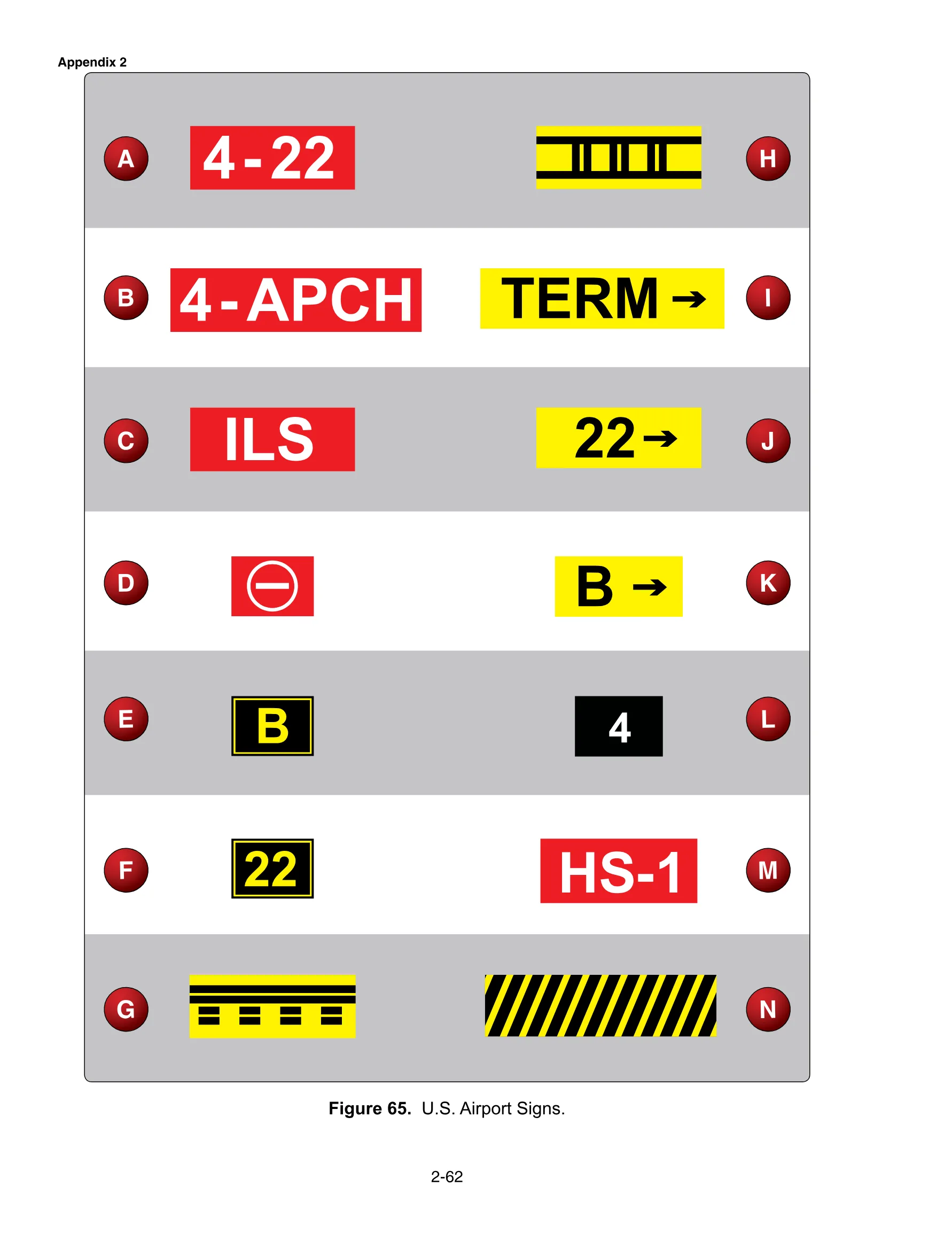
FAA-CT-8080-2H, Figure 65 - At the end of Runway 4 for takeoff
- At the intersection of Runway 4 and another runway
- On a taxiway in the approach area of Runway 4
Show the answer
C. On a taxiway in the approach area of Runway 4 The sign shows the runway designation, a dash, and APCH. It marks a holding spot on a taxiway so an aircraft does not interfere with operations on that runway. AIM 2-3-8
-
54. Which two conditions are necessary for structural icing in flight?
- Visible water, and a temperature above 0 °C where it strikes
- Dry air, and a temperature of 0 °C or colder where it strikes
- Visible water, and a temperature of 0 °C or colder where it strikes
Show the answer
C. Visible water, and a temperature of 0 °C or colder where it strikes Ice needs visible moisture such as rain or cloud droplets, plus freezing temperature at the point where the moisture hits the aircraft. Remote Pilot Study Guide, page 34
-
55. What is the minimum time after drinking any alcoholic beverage before a remote pilot may perform crewmember duties under the regulations?
- 4 hours
- 8 hours
- 12 hours
Show the answer
B. 8 hours The regulations prohibit duties within 8 hours of drinking. The AIM adds that a longer wait is wise. AIM 8-1-1
-
56. Why can a drone hovering 200 feet above a runway be a problem?
- It would block radio signals
- It would break the 87-knot limit
- It may delay manned aircraft takeoffs or landings
Show the answer
C. It may delay manned aircraft takeoffs or landings Even a stationary drone near a runway can interfere with traffic and break the rule against interfering with airport operations. AC 107-2A, page 26
-
57. (Figure 81, Crawford) Besides deer and wildlife, which ground hazard do the airport remarks list on and near the airport?
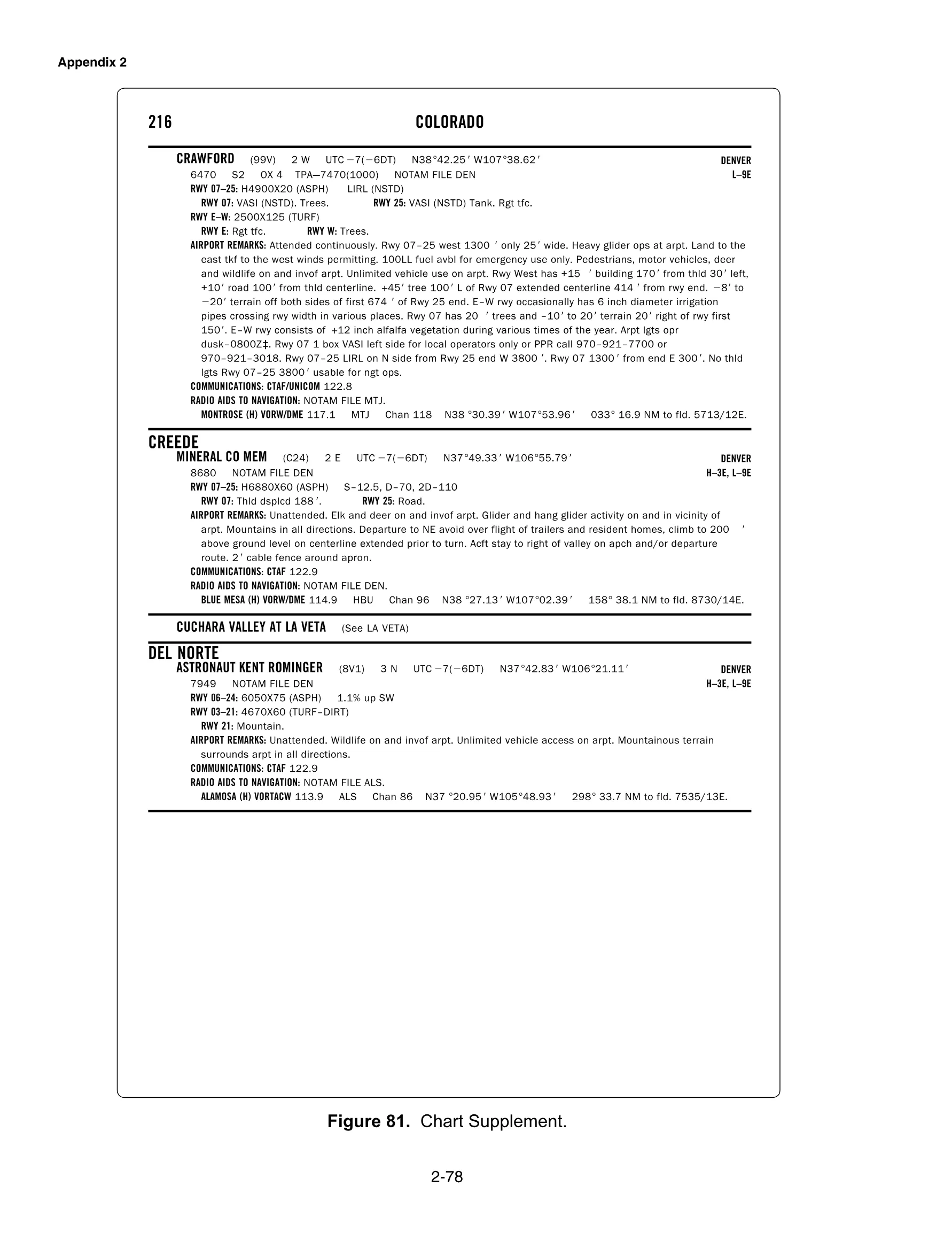
FAA-CT-8080-2H, Figure 81 - Crop duster operations
- Pedestrians and motor vehicles
- Parachute jumpers
Show the answer
B. Pedestrians and motor vehicles The remarks say pedestrians and motor vehicles, as well as deer and wildlife, may be on or near the airport. A remote pilot should expect ground hazards as well as aircraft. Testing Supplement FAA-CT-8080-2H, page 112
-
58. What must the remote ID label that the producer puts on a standard remote ID aircraft show?
- The aircraft's session ID
- The remote pilot's certificate number
- That the aircraft meets the requirements of part 89
Show the answer
C. That the aircraft meets the requirements of part 89 Producers must label standard remote ID aircraft so the label tells the user that the aircraft meets the remote ID rules. 14 CFR 89.525
-
59. Before flying a Category 2 aircraft over people, what must the remote pilot verify about the aircraft?
- It holds a part 21 airworthiness certificate
- It carries a mechanic's certificate approving it for Category 2
- It is properly labeled and listed on an FAA-accepted declaration of compliance
Show the answer
C. It is properly labeled and listed on an FAA-accepted declaration of compliance Besides choosing the right category, the remote pilot is responsible for checking the label and the accepted declaration of compliance. AC 107-2A, page 80
-
60. (Figure 79, Sioux Gateway) On which frequency can a pilot hear the recorded ATIS broadcast?
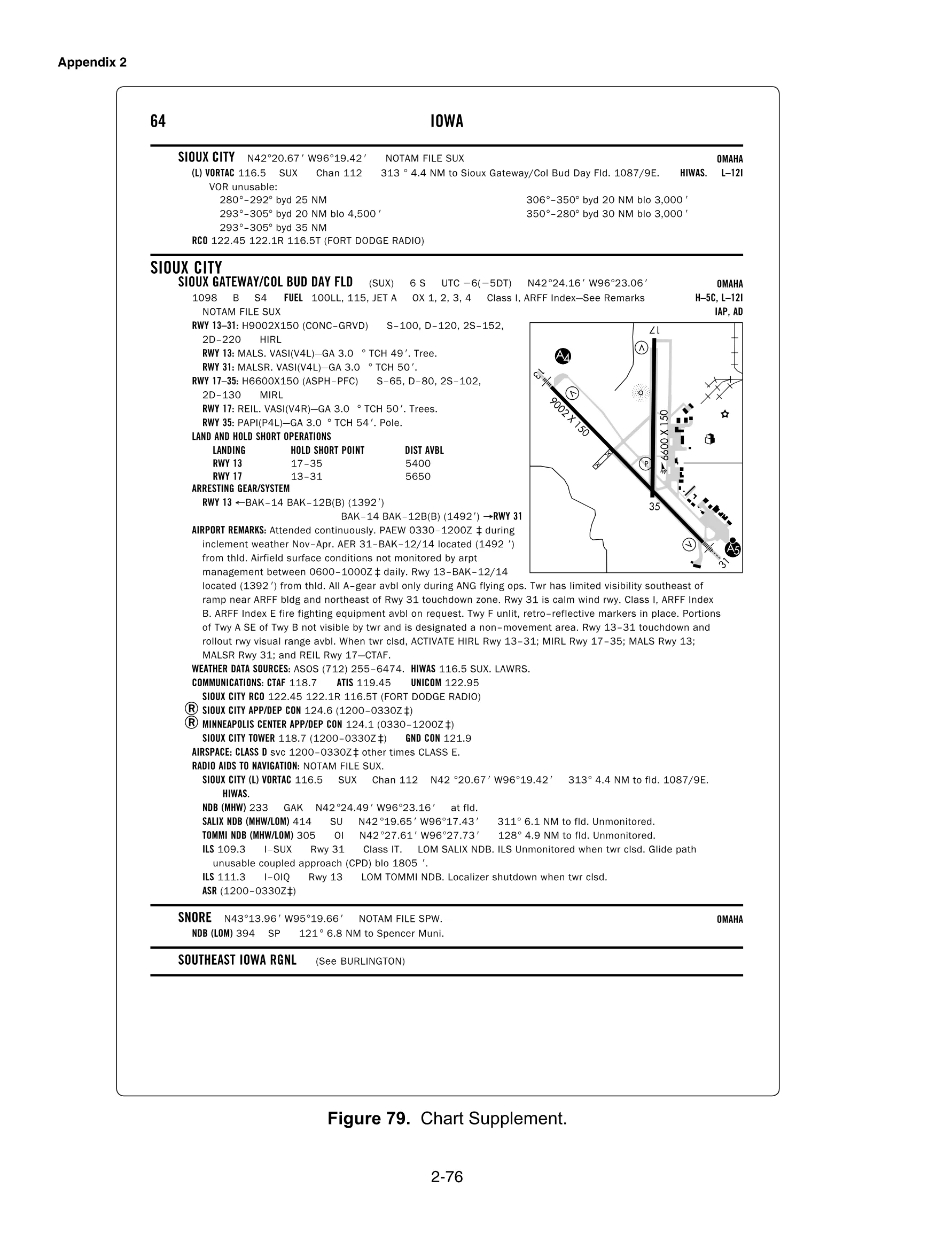
FAA-CT-8080-2H, Figure 79 - 119.45
- 118.7
- 122.95
Show the answer
A. 119.45 ATIS is a recorded broadcast of non-control information, and the airport listing gives its frequency as 119.45. 118.7 is the tower and CTAF frequency and 122.95 is UNICOM. AIM 4-1-13
Part 107 practice test FAQ
How many questions are on the Part 107 test?
The FAA's remote pilot knowledge test (Unmanned Aircraft General - Small, "UAG") has 60 multiple-choice questions, and you have up to two hours. It is in the FAA's Remote Pilot Airman Certification Standards, Appendix 1.
What score do you need to pass the Part 107 test?
70% or better, which is 42 of the 60 questions. A 70% on this site's practice tests is the same bar.
Is this the real FAA test?
No. Easy Drone Test is an independent study site, not affiliated with the FAA. Our questions are written by us from FAA documents and are not the real test questions. You take the real test at an FAA-approved testing center.
Is the practice test free?
Yes. Every practice question, every explanation and every FAA link is free, with no sign-up. Flight Ready, a one-time payment, adds the timed exam simulator, a list of your mistakes, weak-spot drills and your scores on every device.
What does the Part 107 test cover?
Five areas, with the share of the test the FAA gives each: Regulations 15-25%, Airspace Classification and Operating Requirements 15-25%, Weather 11-16%, Loading and Performance 7-11%, and Operations 35-45%.
How long do I wait to retake the test if I fail?
Fourteen calendar days after the failed test (14 CFR 107.71). You show your failed test report at the testing center when you retest.