Airspace Classification and Operating Requirements · 15-25% of the test
Part 107 Airspace Practice Questions
Airspace is 15 to 25 percent of the test and the area where people most often lose points, because the answers depend on knowing which class you are in and what that class asks of a drone pilot.
- 135 questions, all free
- 50 on FAA figures
- No sign-up
- Explained from FAA texts
(Figure 76) The magenta shading around Pierre Rgnl (PIR) marks Class E airspace with what floor?
What to know
- Part 107 requires prior authorization from Air Traffic Control to fly in Class B, Class C or Class D airspace, or inside the surface area of Class E airspace that is designated for an airport.14 CFR 107.41
- Class D airspace is generally the surface to 2,500 feet above the airport elevation around an airport with an operating control tower, and a remote pilot needs ATC authorization before flying in it.Remote Pilot Study Guide, Airspace
- Class E covers the controlled airspace that is not A, B, C or D. In most areas its base is 1,200 feet AGL; in many others it starts at the surface or at 700 feet AGL. Federal Airways are blue lines on a sectional and are usually in Class E.Remote Pilot Study Guide, Class E
- Do not operate in a way that interferes with operations and traffic patterns at any airport, heliport or seaplane base, even where no authorization is needed.14 CFR 107.43
- Before each flight, check NOTAMs, including temporary flight restrictions, to see whether any airspace restriction applies to your operation.AC 107-2A
- Special use airspace, such as restricted and warning areas, is shown on aeronautical charts with the rules for entering it.Chart Users' Guide, Special Use Airspace
ACS tasks in this area
The FAA's Airman Certification Standards list what the test covers. Our questions are tagged to these tasks.
- II.A Airspace Classification74 practice questions
- II.B Airspace Operational Requirements61 practice questions
More practice
Other areas of the Part 107 test, and the mixed practice tests.
Flight Ready
Practice until you're ready for the real test
Every practice question is free. Flight Ready adds:
- The exam simulator: 60 questions by the real test's mix, a 2-hour timer, answers only at the end
- My mistakes: each miss comes back until you get it right twice in a row
- Weak-spot drills from your lowest-scoring ACS tasks, and a readiness view
- Your scores and mistakes on every device you log in on
- Paid once, US$4.49. Never a subscription
14-day refunds, no questions asked.
Airspace Classification and Operating Requirements test 1: questions and answers
-
1. (Figure 76) The magenta shading around Pierre Rgnl (PIR) marks Class E airspace with what floor?
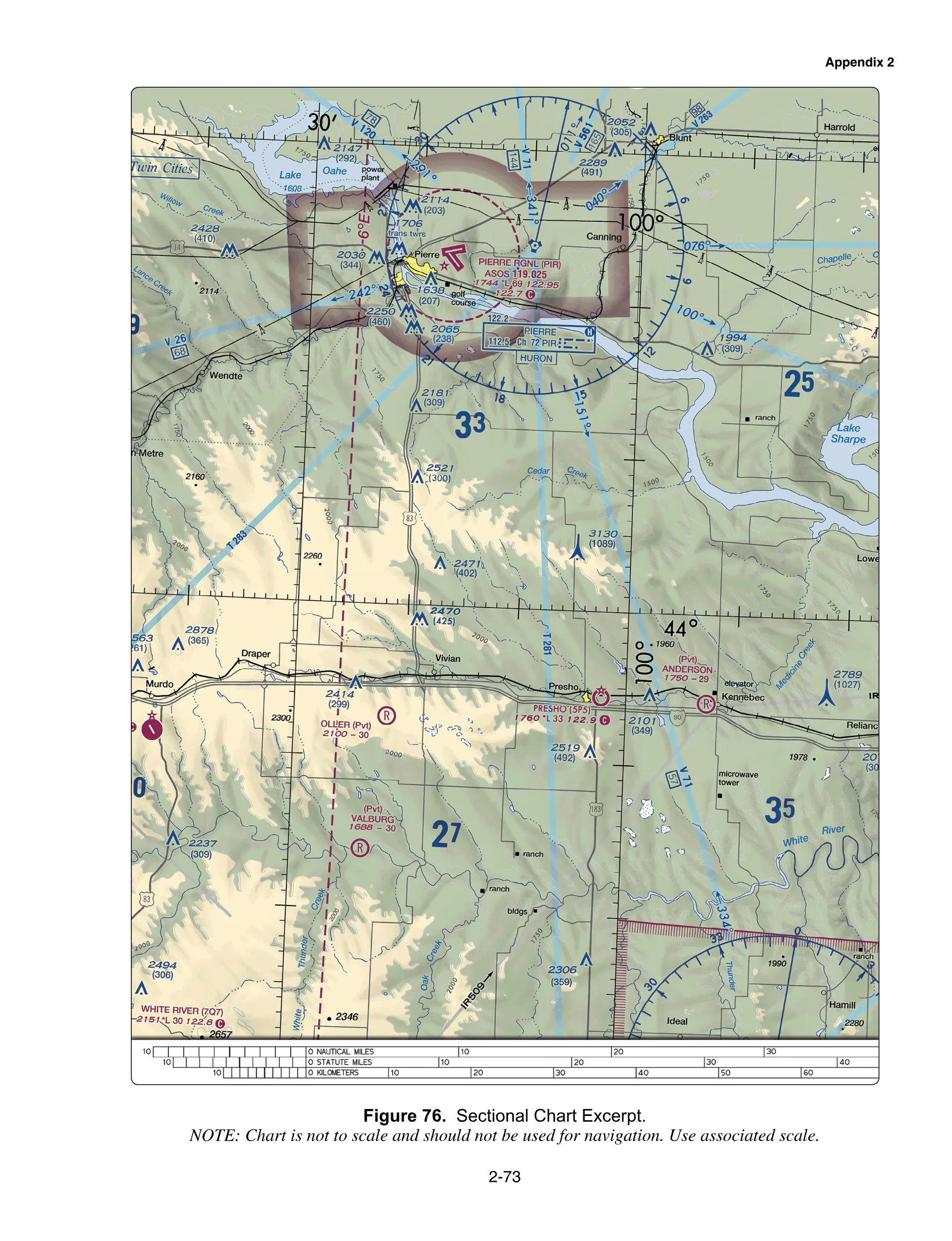
FAA-CT-8080-2H, Figure 76 - The surface
- 1,200 feet above the surface
- 700 feet above the surface
Show the answer
C. 700 feet above the surface A magenta vignette marks Class E airspace that starts 700 feet above the surface. A blue vignette marks a floor of 1,200 feet or more. Testing Supplement FAA-CT-8080-2H, page 13
-
2. (Figure 23, Savannah Class C) The inner ring is labeled 41 over SFC. What is the ceiling of that Class C airspace?
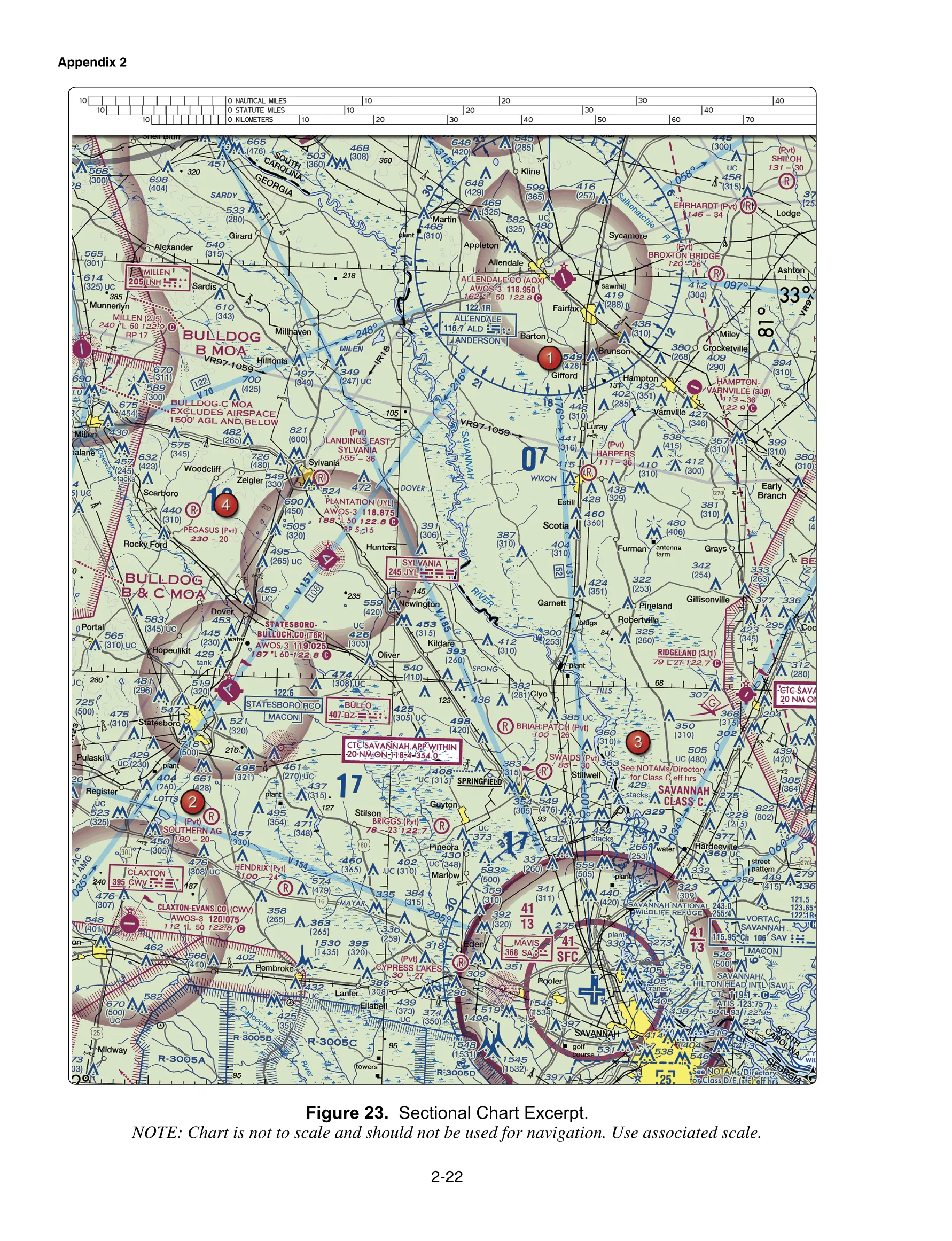
FAA-CT-8080-2H, Figure 23 - 4,100 feet MSL
- 4,100 feet AGL
- 410 feet MSL
Show the answer
A. 4,100 feet MSL Class C floors and ceilings are printed in hundreds of feet MSL with the last two zeros dropped. So 41 means 4,100 feet MSL, and SFC means the floor is the surface. Chart Users' Guide, page 16
-
3. What must the small unmanned aircraft have during civil twilight?
- Lighted anti-collision lighting visible for at least 3 statute miles
- No special equipment
- A ground observer on the radio
Show the answer
A. Lighted anti-collision lighting visible for at least 3 statute miles The same anti-collision light needed at night is also required in the twilight periods. 14 CFR 107.29
-
4. A skeletal tower's guy wires can reach about 1,500 feet out. What is the smallest recommended horizontal distance to keep from the tower?
- 1,500 feet
- 500 feet
- 2,000 feet
Show the answer
C. 2,000 feet Guy wires can reach 1,500 feet out, so keep 2,000 feet clear. AIM 7-6-4
-
5. What are pilots asked to do about a depicted national security area (NSA)?
- Voluntarily avoid flying through it
- Obtain an ATC clearance
- Request authorization from the controlling agency
Show the answer
A. Voluntarily avoid flying through it NSAs ask pilots to stay out on a voluntary basis. If security demands it, flight can be prohibited by NOTAM. AIM 3-4-8
-
6. The remote pilot may reduce the anti-collision light's intensity in what case?
- Whenever the pilot wants to save battery
- Never, it must be at full intensity
- If the light would be a safety hazard in the operating conditions
Show the answer
C. If the light would be a safety hazard in the operating conditions The pilot may dim it for safety but may never turn it off. AC 107-2A, page 23
-
7. What are small UAS operators encouraged to monitor when flying on or near an airport?
- The ATIS only
- The tower frequency to give position reports
- Local CTAF radio traffic
Show the answer
C. Local CTAF radio traffic Listening to CTAF improves situational awareness about manned traffic near the airport. AIM 11-8-2
-
8. Class C airspace generally extends from the surface to what height above the airport elevation?
- 2,500 feet
- 10,000 feet
- 4,000 feet
Show the answer
C. 4,000 feet Class C surrounds airports with a control tower and radar approach control, and it reaches 4,000 feet above the airport elevation. Remote Pilot Study Guide, page 14
-
9. (Figure 70) What must a manned aircraft have before operating inside the San Francisco Class B airspace?
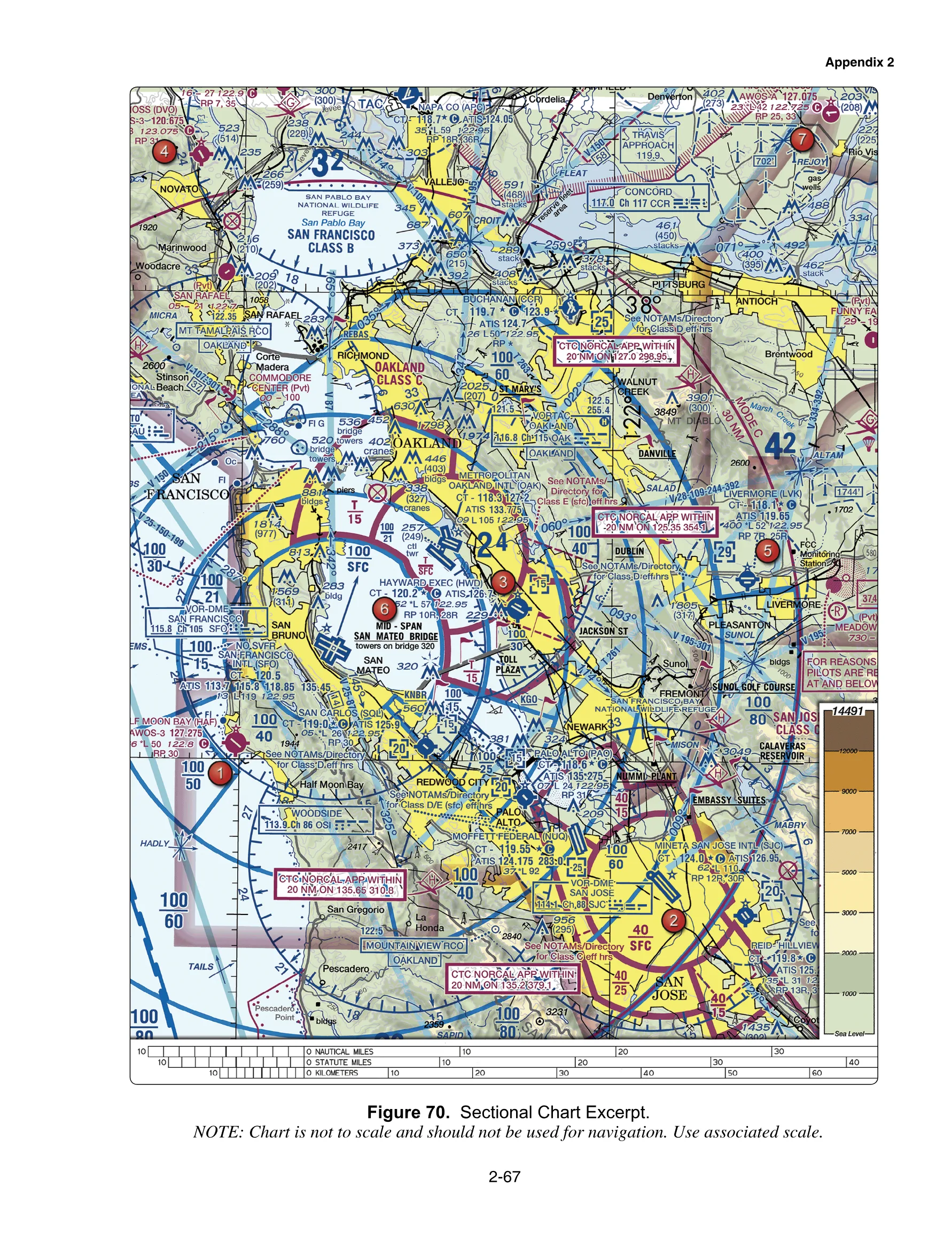
FAA-CT-8080-2H, Figure 70 - An ATC clearance, regardless of weather
- An ATC clearance only when visibility is below 3 statute miles
- No clearance if the aircraft stays below the ceiling
Show the answer
A. An ATC clearance, regardless of weather Manned aircraft need an ATC clearance before operating in Class B, whatever the weather. A remote pilot needs prior ATC authorization under 107.41 instead. AIM 3-2-3
-
10. (Figure 70, area 2) What does a remote pilot need before flying a small unmanned aircraft in this Class C airspace?
FAA-CT-8080-2H, Figure 70 - Prior authorization from ATC
- Nothing, if flying below 400 feet AGL
- Two-way radio contact with the approach controller
Show the answer
A. Prior authorization from ATC A remote pilot needs prior ATC authorization to fly in Class B, C or D airspace or an airport's Class E surface area, at any altitude. Two-way radio contact is what manned aircraft need to enter Class C. 14 CFR 107.41
-
11. Class B airspace generally extends from the surface up to what altitude?
- 10,000 feet MSL
- 4,000 feet AGL
- 18,000 feet MSL
Show the answer
A. 10,000 feet MSL Class B surrounds the busiest airports and is built like an upside-down wedding cake, topping out at 10,000 feet MSL. Remote Pilot Study Guide, page 13
-
12. What is the maximum altitude for a small unmanned aircraft, unless flown near a structure?
- 200 feet AGL
- 500 feet MSL
- 400 feet AGL
Show the answer
C. 400 feet AGL The default ceiling is 400 feet above ground level. 14 CFR 107.51
-
13. (Figure 59, area 4) What does the magenta boxed note CTC TOLEDO APP WITHIN 20 NM ON 126.1 307.0 give?
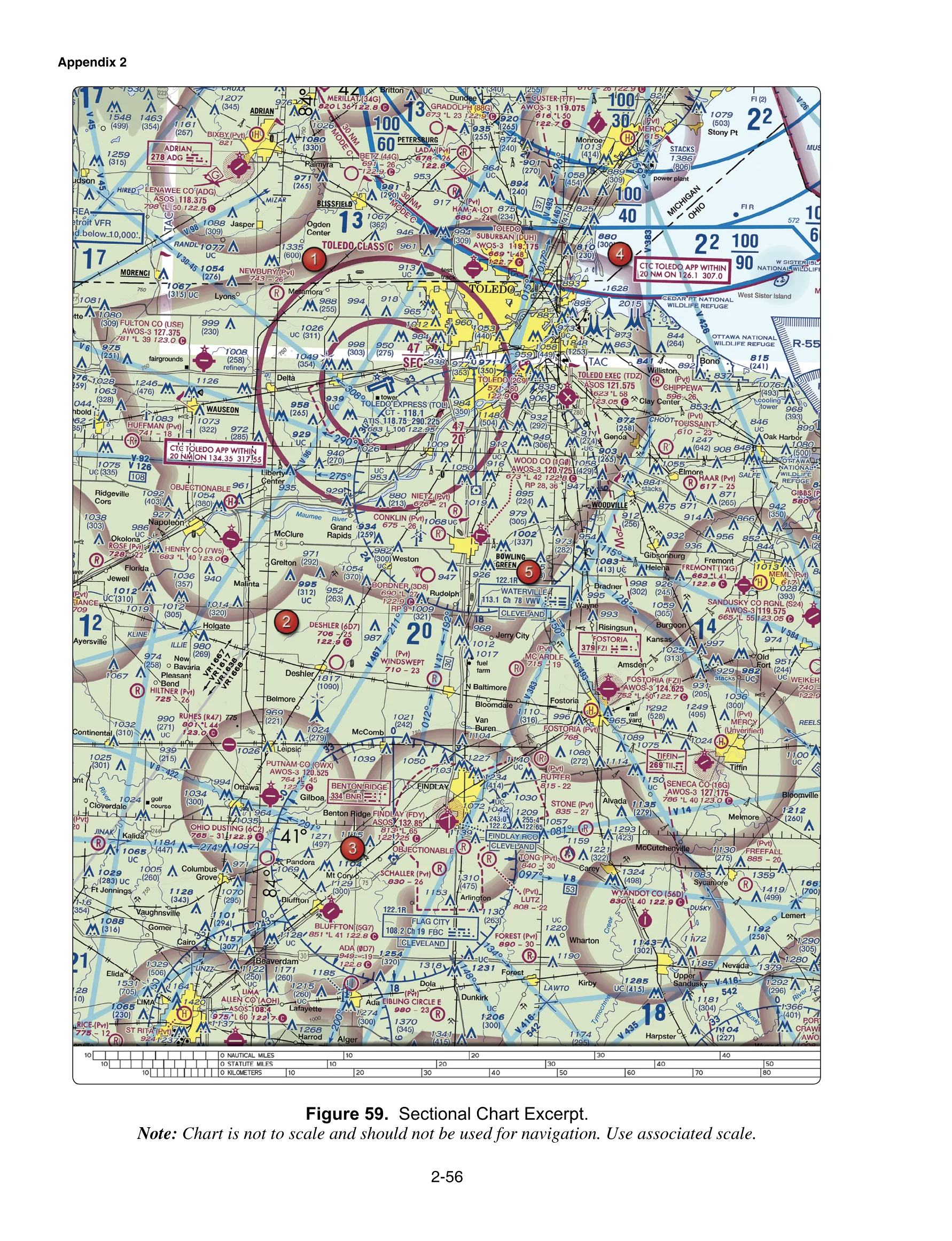
FAA-CT-8080-2H, Figure 59 - Tower frequencies for Toledo Executive
- ATIS and AWOS frequencies for Toledo Express
- Approach control frequencies for manned VFR aircraft arriving at the Class C
Show the answer
C. Approach control frequencies for manned VFR aircraft arriving at the Class C A boxed note like this gives the approach control frequencies that arriving manned VFR aircraft use to establish two-way radio contact before entering the Class C, generally within 20 NM. A remote pilot instead needs prior ATC authorization to fly in Class C airspace (107.41). Chart Users' Guide, page 16
-
14. What size area is a temporary flight restriction normally limited to in order to protect persons and property?
- 500 feet above the surface and a 1-mile radius
- 10,000 feet above the surface and a 10-mile radius
- 2,000 feet above the surface and a 3-nautical-mile radius
Show the answer
C. 2,000 feet above the surface and a 3-nautical-mile radius A TFR protecting a hazard on the surface is normally limited to 2,000 feet above the surface within a 3 NM radius, though some TFRs are larger. AIM 3-5-3
-
15. What should pilots do in an alert area?
- Obtain a clearance first
- Avoid the area completely
- Exercise caution
Show the answer
C. Exercise caution Alert areas hold unusual activity such as heavy flight training. Flying there is allowed, with extra caution. Remote Pilot Study Guide, page 17
-
16. (Figure 69, area 6) What type of special use airspace is A-632C, where area 6 lies?
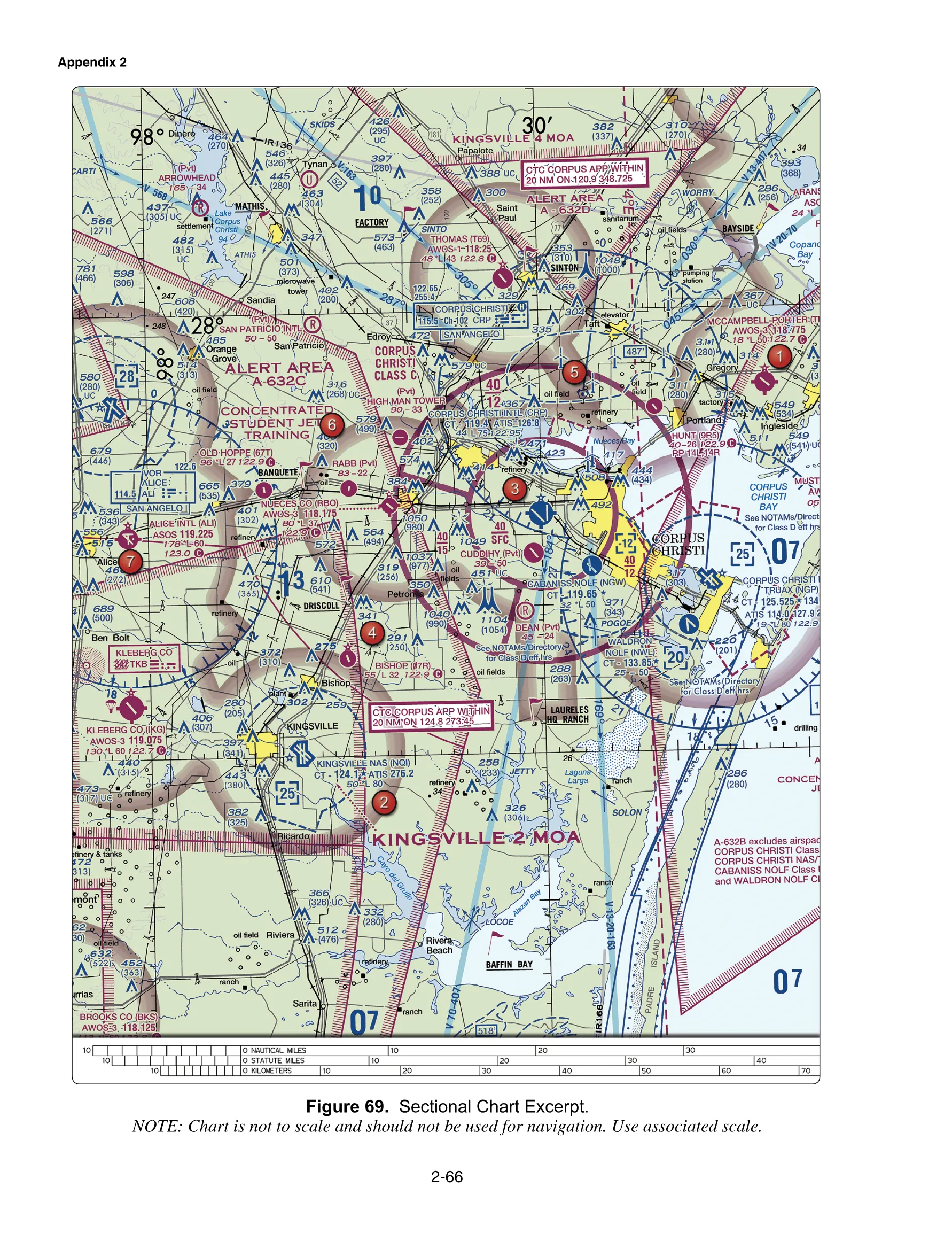
FAA-CT-8080-2H, Figure 69 - Alert area
- Restricted area
- Military operations area
Show the answer
A. Alert area An A-number marks an alert area. These charted areas warn pilots of heavy student pilot training or unusual aerial activity, and everyone must watch for traffic. AIM 3-4-6
-
17. What do wires and unmarked towers pose to pilots flying at and below 200 feet AGL?
- They are always lighted and charted
- They may not be seen in time to avoid a collision
- They only matter above 400 feet
Show the answer
B. They may not be seen in time to avoid a collision At low altitude many wires and towers are not marked, lighted, or charted. AIM 7-6-4
-
18. (Figure 80) The chart says "See NOTAMs/Directory for Class E (sfc) eff hrs" near Montrose. Where do you check the surface area status?
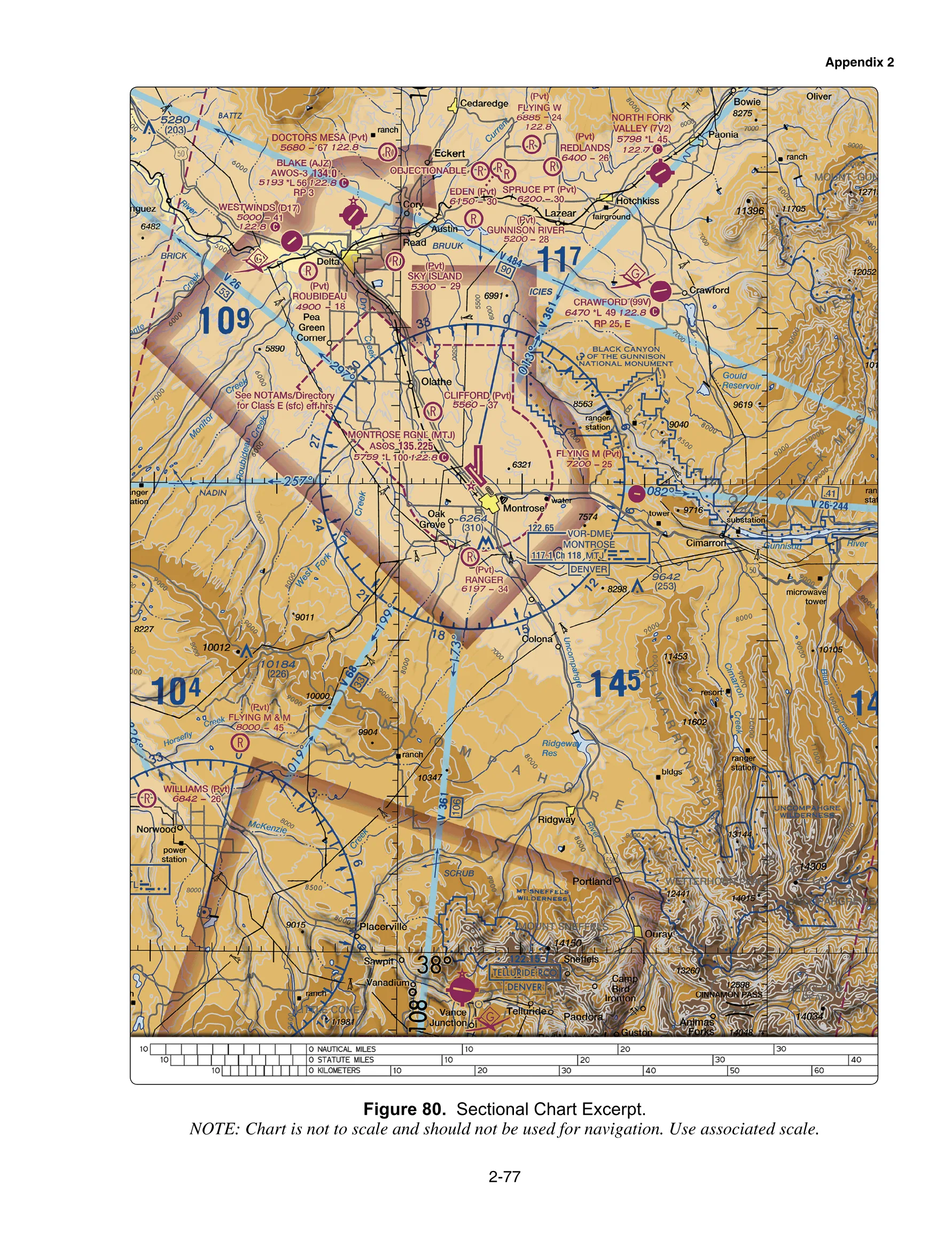
FAA-CT-8080-2H, Figure 80 - The airport page in the Chart Supplement
- The legend on the sectional chart
- The airport's ASOS weather broadcast
Show the answer
A. The airport page in the Chart Supplement Class E surface area times and status are listed with the airport in the Chart Supplement, so check it before flight. AIM 3-2-6
-
19. Federal airways are what class of airspace, and where do they begin?
- Class G, from the surface
- Class D, from 700 feet AGL
- Class E, from 1,200 feet AGL
Show the answer
C. Class E, from 1,200 feet AGL Airways are Class E corridors that start at 1,200 feet AGL and run up to, but not including, 18,000 feet MSL. AIM 3-2-6
-
20. Should small UAS operators contact ATC directly by radio or telephone to gain airspace access?
- Yes, always by radio
- No, they should not
- Yes, but only by telephone
Show the answer
B. No, they should not Airspace access goes through systems like LAANC, not direct calls to ATC. AIM 11-8-2
-
21. Which pair of special use airspace types is regulatory and set up under 14 CFR part 73?
- Prohibited and restricted areas
- Warning areas and MOAs
- Alert areas and national security areas
Show the answer
A. Prohibited and restricted areas Prohibited and restricted areas are regulatory, made through rulemaking. The other types are nonregulatory. AIM 3-4-1
-
22. What is the purpose of a Military Operations Area (MOA)?
- To separate certain military training from IFR traffic
- To protect the President while traveling
- To mark parachute drop zones
Show the answer
A. To separate certain military training from IFR traffic MOAs keep military training away from IFR traffic. Pilots in the area should be alert for military aircraft. AIM 3-4-5
-
23. In Class D airspace, what separation services does ATC provide to VFR aircraft?
- No separation services
- Separation from all other aircraft
- Separation from IFR aircraft only
Show the answer
A. No separation services In Class D, ATC gives VFR aircraft no separation from any traffic, VFR or IFR, so every pilot must see and avoid. AIM 3-2-5
-
24. (Figure 69, Corpus Christi Class C) A manned pilot calls approach and hears "(callsign), standby." What does that mean for that pilot?
FAA-CT-8080-2H, Figure 69 - Contact has not been made, so the pilot must stay out
- Two-way contact is established, so the pilot may enter
- The pilot must climb above the Class C ceiling
Show the answer
B. Two-way contact is established, so the pilot may enter If the controller uses the aircraft's callsign, even to say standby, two-way communication exists and the manned pilot may enter. A reply without the callsign does not count. A remote pilot needs prior ATC authorization (107.41) instead. AIM 3-2-4
-
25. (Figure 25) Arlington Municipal (GKY) has a blue dashed Class D area with -20 in a dashed box. What does that show?
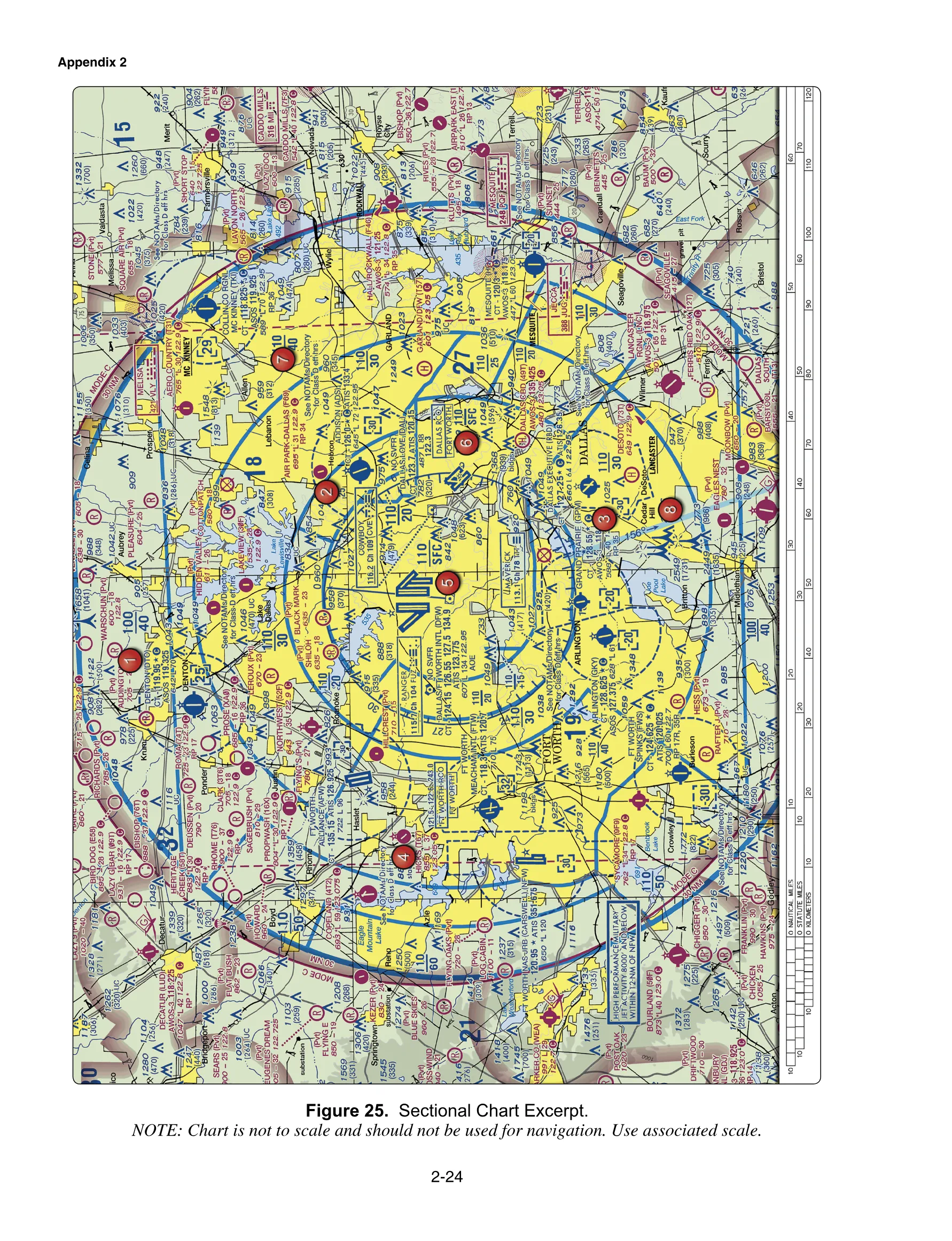
FAA-CT-8080-2H, Figure 25 - Surface up to, but not including, 2,000 feet MSL
- A floor of 2,000 feet MSL up to 18,000 feet MSL
- Surface up to, but not including, 200 feet AGL
Show the answer
A. Surface up to, but not including, 2,000 feet MSL A Class D ceiling is given in hundreds of feet MSL. The minus sign means the airspace runs from the surface up to, but not including, that value, so -20 means up to 2,000 feet MSL. Testing Supplement FAA-CT-8080-2H, page 13
Airspace Classification and Operating Requirements FAQ
Which airspace needs ATC authorization for a drone?
Class B, Class C, Class D, and the lateral boundaries of the surface area of Class E airspace designated for an airport (14 CFR 107.41). Flying there without prior authorization from ATC is not allowed.
Where does Class E airspace start?
It depends on the chart. In most areas the base is 1,200 feet AGL, in many others 700 feet AGL or the surface, and where no base is charted it begins at 14,500 feet MSL (Remote Pilot Study Guide).
Do I need to check NOTAMs before flying a drone?
Yes, before every flight (AC 107-2A). A NOTAM can restrict airspace at short notice, such as a temporary flight restriction over a wildfire, so last week's check tells you nothing about today.
Do airspace questions on the test use a chart?
Many do. They show an excerpt of a sectional chart from the FAA testing supplement, and you read the airspace from it. Our sectional chart practice page uses the same kind of figures.