Loading and Performance · 7-11% of the test
Part 107 Loading and Performance Questions
The smallest area, 7 to 11 percent of the test, is about how weight, balance and flight maneuvers change what your aircraft can do.
- 41 questions, all free
- 3 on FAA figures
- No sign-up
- Explained from FAA texts
Compared with a properly loaded aircraft, what does an overloaded aircraft need for takeoff?
What to know
- Staying inside the weight and balance limits is critical. Flying over the maximum weight hurts performance and the structure, and a center of gravity outside the approved limits makes the aircraft hard to control.Remote Pilot Study Guide, Weight and Balance
- A small unmanned aircraft weighs less than 55 pounds on takeoff, counting everything on board or attached to it.14 CFR 107.3
- A load factor of 3 means the total load on the structure is three times the aircraft's weight. Load factors are expressed in Gs, and the testing supplement's load factor chart (Figure 2) is used in the questions.Remote Pilot Study Guide, Load Factors
- A drone may not carry hazardous material, and may not drop an object in a way that creates an undue hazard to people or property.14 CFR 107.36, 107.23
ACS tasks in this area
The FAA's Airman Certification Standards list what the test covers. Our questions are tagged to these tasks.
- IV.A Loading and Performance41 practice questions
More practice
Other areas of the Part 107 test, and the mixed practice tests.
Flight Ready
Practice until you're ready for the real test
Every practice question is free. Flight Ready adds:
- The exam simulator: 60 questions by the real test's mix, a 2-hour timer, answers only at the end
- My mistakes: each miss comes back until you get it right twice in a row
- Weak-spot drills from your lowest-scoring ACS tasks, and a readiness view
- Your scores and mistakes on every device you log in on
- Paid once, US$4.49. Never a subscription
14-day refunds, no questions asked.
Loading and Performance test 1: questions and answers
-
1. Compared with a properly loaded aircraft, what does an overloaded aircraft need for takeoff?
- A shorter takeoff run
- A longer takeoff run
- A lower takeoff speed
Show the answer
B. A longer takeoff run Excess weight reduces performance almost across the board. Takeoff speed and takeoff run both increase. Remote Pilot Study Guide, page 41
-
2. A remote pilot adds or removes equipment on the aircraft. Which statement is correct?
- The change can alter the aircraft's CG
- The CG cannot change if total weight stays under the limit
- Only the weight changes, never the CG
Show the answer
A. The change can alter the aircraft's CG Equipment has weight and a location, so adding or removing it can move the CG. Check balance again after any change. Pilot's Handbook of Aeronautical Knowledge, page 248
-
3. How should a remote pilot treat the manufacturer's performance data for takeoff, climb, range and landing?
- As essential for safe and efficient operation
- As optional once the aircraft has flown a few times
- As needed only for commercial operations
Show the answer
A. As essential for safe and efficient operation Performance data tells the pilot what the aircraft can and cannot do. Using it in flying operations is essential for safe and efficient operation. Remote Pilot Study Guide, page 51
-
4. An aircraft's maximum weight is 3,400 lb and its CG range is 78 to 86 inches. It weighs 3,320 lb with the CG at 84.8 inches. Is it loaded within limits?
- No, the weight is over the maximum
- Yes, both the weight and the CG are within limits
- No, the CG is beyond the aft limit
Show the answer
B. Yes, both the weight and the CG are within limits The weight is below the maximum, and the CG falls inside the allowed range, so the loading is acceptable. Pilot's Handbook of Aeronautical Knowledge, page 251
-
5. A load factor of 3 is applied to an aircraft. What is the total load on its structure?
- 3 times its weight
- The same as its weight
- One-third of its weight
Show the answer
A. 3 times its weight Load factor is a multiple of the aircraft's weight, measured in Gs. A load factor of 3 (3 Gs) loads the structure to three times its weight. Remote Pilot Study Guide, page 38
-
6. Before flight, what should the remote PIC determine to verify the aircraft is correctly loaded?
- The weight and balance condition of the aircraft
- Whether the aircraft's registration marking is visible
- How much battery power is left for the planned flight
Show the answer
A. The weight and balance condition of the aircraft Loading is verified by checking weight and balance. A correctly loaded aircraft is within its weight limit and its center of gravity (CG) limits. Remote Pilot Study Guide, page 37
-
7. What is the load factor in a coordinated, level turn at 60 degrees of bank?
- 1 G
- 2 Gs
- 3 Gs
Show the answer
B. 2 Gs Load factor climbs quickly as bank increases. At 60 degrees of bank in a level turn the wing must carry twice the aircraft's weight, or 2 Gs. Pilot's Handbook of Aeronautical Knowledge, page 131
-
8. What must the remote PIC ensure about any object attached to or carried by the small unmanned aircraft?
- It is registered separately with the FAA
- It is secure and does not adversely affect flight characteristics or controllability
- It is approved in writing by air traffic control
Show the answer
B. It is secure and does not adversely affect flight characteristics or controllability Attached items change weight and balance. The remote PIC must make sure they are secure and do not harm how the aircraft flies or responds to controls. AC 107-2A, page 28
-
9. An aircraft normally stalls at 50 knots. What is its stalling speed at a load factor of 4 Gs?
- 150 knots
- 75 knots
- 100 knots
Show the answer
C. 100 knots Stalling speed rises with the square root of the load factor. A load factor of 4 doubles the stalling speed, so a stall can happen at seemingly safe speeds. Remote Pilot Study Guide, page 39
-
10. Which set of conditions is most indicative of low density altitude (dense air)?
- Low elevation, high pressure, low temperature, low humidity
- High elevation, low pressure, high temperature, high humidity
- Low elevation, low pressure, high temperature, low humidity
Show the answer
A. Low elevation, high pressure, low temperature, low humidity Low density altitude means dense air and better performance. It goes with low ground, high pressure, cool temperatures and dry air. Pilot's Handbook of Aeronautical Knowledge, page 260
-
11. The CG is forward of the center of pressure (CP), where lift acts. Which way does the aircraft tend to pitch?
- Nose up
- Nose down
- It has no pitching tendency
Show the answer
B. Nose down With the weight ahead of where lift acts, the aircraft tends to pitch nose down. Designers set the aft CG limit ahead of the CP to keep the aircraft in equilibrium. Remote Pilot Study Guide, page 37
-
12. Air density increases, giving a lower density altitude. How does aircraft performance change?
- Performance decreases
- Performance does not change
- Performance increases
Show the answer
C. Performance increases Denser air means a lower density altitude, and denser air supports better performance. Thin air (high density altitude) does the opposite. Pilot's Handbook of Aeronautical Knowledge, page 259
-
13. What may cause a small unmanned aircraft's weight to change during flight?
- A change in the outside air temperature during the flight
- Using expendable items on board, such as releasing a jettisonable load
- Flying from low ground over to higher ground
Show the answer
B. Using expendable items on board, such as releasing a jettisonable load Weight changes in flight when something on board is used up or dropped, such as a jettisonable load. That also changes performance and may move the CG. Remote Pilot Study Guide, page 37
-
14. What does a rise in the water content (humidity) of the air do to density altitude and performance?
- Raises density altitude and improves performance
- Raises density altitude and decreases performance
- Lowers density altitude and improves performance
Show the answer
B. Raises density altitude and decreases performance Water vapor is lighter than air, so moist air is less dense. That means a higher density altitude and poorer performance. Remote Pilot Study Guide, page 51
-
15. At constant pressure, what happens to air density when the temperature goes up?
- It decreases
- It increases
- It stays the same
Show the answer
A. It decreases Warm air is less dense, so hot days give a higher density altitude and weaker performance. Cold air is denser. Remote Pilot Study Guide, page 51
-
16. (Figure 2) In a level turn, steepening the bank from 60° to 70° adds about how much load factor?
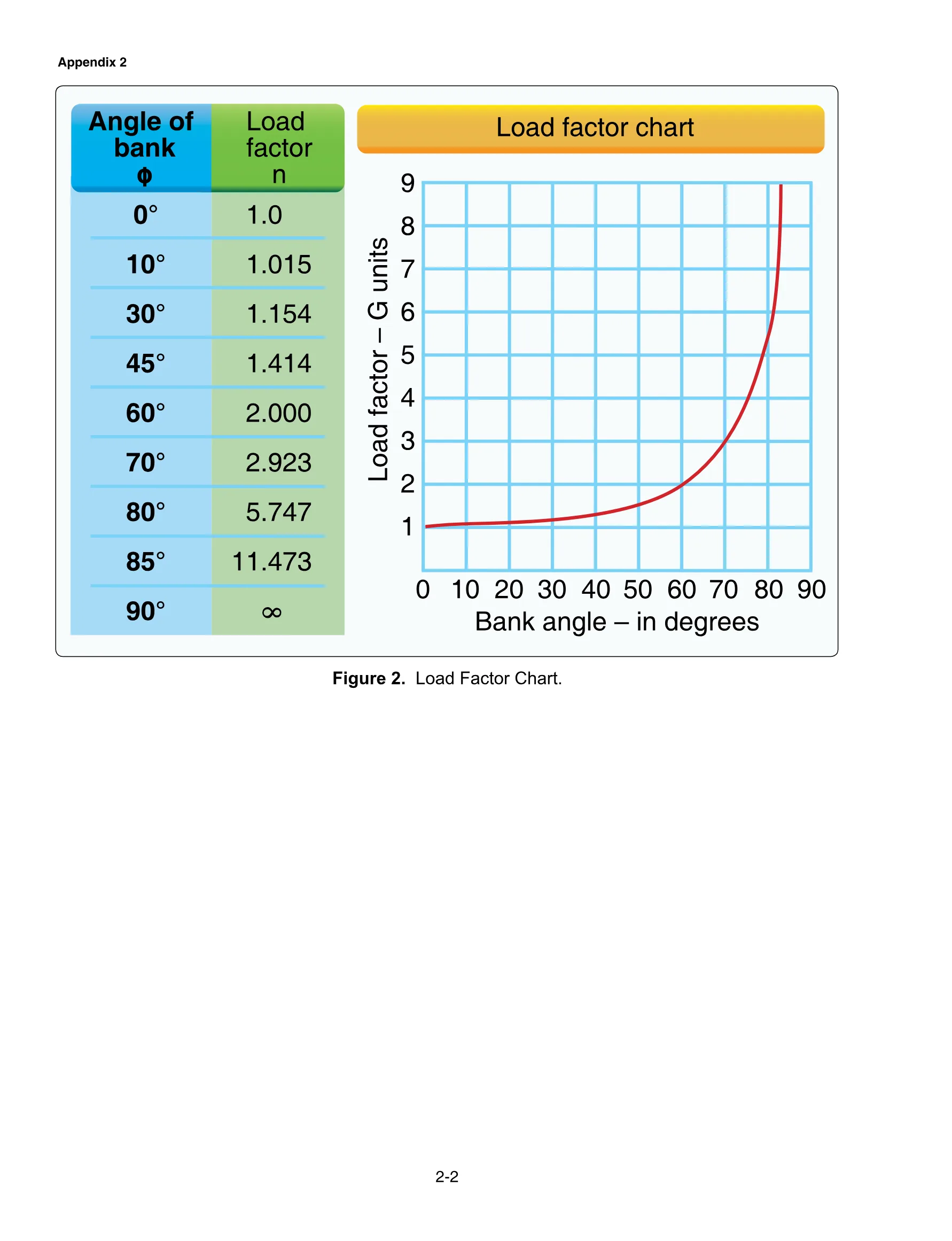
FAA-CT-8080-2H, Figure 2 - 0.5 G
- 2 G
- About 1 G
Show the answer
C. About 1 G The chart goes from 2.000 at 60° to 2.923 at 70°, a rise of about 1 G. Load factor climbs faster the steeper the bank gets. Pilot's Handbook of Aeronautical Knowledge, page 131
-
17. What happens to stability as the CG moves aft?
- The aircraft becomes more stable
- Stability is not affected
- The aircraft becomes less stable
Show the answer
C. The aircraft becomes less stable An aft CG means a less stable condition. The aircraft is less able to right itself after a maneuver or turbulence. Pilot's Handbook of Aeronautical Knowledge, page 247
-
18. Which term describes an aircraft's inherent quality to correct for disturbances and return to its original flight path?
- Maneuverability
- Controllability
- Stability
Show the answer
C. Stability Stability is mostly a design characteristic. Maneuverability is how easily the aircraft can be maneuvered, and controllability is how it responds to the pilot's inputs. Remote Pilot Study Guide, page 38
-
19. After loading, the CG is outside the allowable limits. What must the remote PIC do before flight?
- Relocate or shed some weight
- Fly at a lower speed to make up for it
- Lower the maximum altitude planned for the flight
Show the answer
A. Relocate or shed some weight An out-of-limits CG makes the aircraft hard to control. The load has to be moved or reduced until the CG is inside the limits. Remote Pilot Study Guide, page 37
-
20. How does air density generally change as altitude increases?
- It increases
- It stays the same
- It decreases
Show the answer
C. It decreases Both temperature and pressure drop with height, but the fast fall in pressure dominates, so air gets thinner as you climb. Remote Pilot Study Guide, page 51
Loading and Performance FAQ
What is the maximum weight of a small unmanned aircraft under Part 107?
It must weigh less than 55 pounds on takeoff, including everything on board or attached (14 CFR 107.3).
What happens if the center of gravity is outside the limits?
The study guide says operating with the center of gravity outside the approved limits results in control difficulty.
What is a load factor?
The ratio of the load on the aircraft's structure to its weight, in Gs. A load factor of 3 means three times the weight (Remote Pilot Study Guide).